
This MiCA Compliance Guide for Telegram Forex answers the most critical legal question for paid group admins: do you need a license? Your compliance depends entirely on whether your signals are broadcast or personalized. Forex Signals: Currency trades fall entirely under MiFID II regulations and remain completely separate from MiCA. Public Crypto Signals: General one to many posts sit outside MiCA licensing requirements. VIP Personalized Signals: Tailored recommendations based on individual portfolios legally count as financial advice and require a MiCA license.
That’s the short version. The rest of this guide walks through why the distinction matters, how EU regulators actually test it, and what a signal group admin should be doing right now to stay on the right side of the line.
What MiCA Actually Regulates (and What It Doesn’t)
MiCA, officially Regulation (EU) 2023/1114, is the European Union’s first comprehensive legal framework for crypto assets. It became fully applicable on December 30, 2024, and it governs three things: issuers of crypto assets, crypto asset service providers (known as CASPs), and the marketing and disclosure rules that apply to anyone promoting those services to EU consumers.
A CASP is a broad category. It covers exchanges, custody providers, portfolio managers dealing in crypto, and, importantly for this article, anyone giving advice on crypto assets. Trading platforms, wallet providers, and stablecoin issuers were the first businesses to feel MiCA’s weight, and most of the coverage online is written for them, not for a Telegram admin running a signal channel on the side.
Here’s the part that matters for you. The transitional period that let existing service providers keep operating under old national rules while they applied for a MiCA license came to an end across the EU on July 1, 2026. After that date, any entity offering crypto asset services to EU clients without a MiCA license is operating in breach of EU law, according to ESMA’s own statement on the matter. National regulators have been told to start enforcement action against firms that missed the deadline. That timeline is why this question isn’t theoretical anymore for anyone with EU subscribers.
Building the best Telegram trading community for European users means understanding that national regulators in countries like the Netherlands are actively monitoring retail groups for unlicensed activities.
Many channel operators assume that running their business from outside the European Union completely shields them from these regulations. This is a very dangerous assumption because European authorities apply these rules based on where your subscribers reside rather than where your company is registered. If you actively market your premium group to European citizens or run advertisements targeting European countries you fall directly under their jurisdiction.
There is a narrow legal exception known as reverse solicitation which applies only if a European client finds your service completely on their own without any active marketing from your side. Relying on this exception is extremely risky for a public Telegram channel and regulators often reject it as a valid defense during compliance audits.
Why Forex Signals Fall Outside MiCA
This is where a lot of confusion starts, and honestly, where a lot of competing articles get sloppy. Forex is not a crypto asset. A signal calling entries and exits on EUR/USD or GBP/JPY has nothing to do with MiCA’s scope. Forex signals, CFDs, and other traditional financial instruments fall under MiFID II, the EU’s older and separate rulebook for investment services.
MiFID II brings its own restrictions that are arguably tighter than MiCA’s in some respects. Retail CFD leverage is capped at 30 to 1 for major currency pairs, 20 to 1 for indices, and lower still for individual stocks. Negative balance protection is mandatory, bonus promotions to retail clients are banned outright, and unlicensed investment advice is prohibited across every member state. If you run a mixed group that covers both forex and crypto calls, you’re effectively juggling two separate regulatory regimes at once, not one.
Treating MiCA as if it covers your whole channel is a mistake that could leave your forex side completely unaddressed. Running a dual asset channel adds regulatory overhead and forces administrators to carefully evaluate if the effort is worth the reward. Many operators eventually sit down to calculate exactly how much can you earn selling forex signals before committing to compliance under the MiFID II framework.
| Signal type | Governing regulation | Applies to Telegram groups? |
|---|---|---|
| Crypto asset trading signals | MiCA | Yes, if personalized or paid advice |
| Forex and CFD signals | MiFID II | Yes, separately from MiCA |
| Stock and equity tips | MiFID II | Yes, separately from MiCA |
| General crypto news or education | Neither (no advice given) | Generally no |
When Does Giving Crypto Signals Count as “Advice” Under MiCA?
This is the question that decides everything else. MiCA doesn’t regulate every mention of a coin. It regulates advice, and it defines advice narrowly enough that a lot of public channel content escapes it, but broadly enough that plenty of paid VIP setups walk right into it.
The ESMA Test for Personalized Recommendations
In June 2026, ESMA published a formal answer clarifying how the perimeter of “advice on crypto assets” should be read under MiCA. The regulator stated plainly that this perimeter is broader than investment advice under MiFID II, because MiCA’s definition covers offering or agreeing to give personalized recommendations about either specific crypto asset transactions or the use of crypto asset services generally.
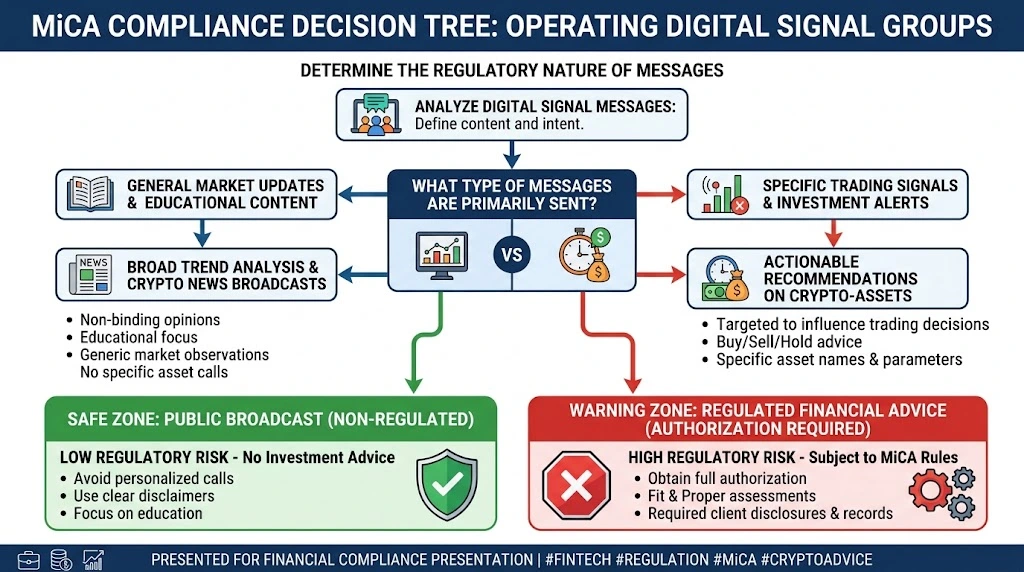
ESMA laid out a practical set of questions to determine whether something counts as advice:
- Does the communication constitute a recommendation, rather than general information?
- Is that recommendation about a transaction in crypto assets, or about using a crypto asset service?
- Is it presented as suitable for that person, or based on their specific circumstances?
- Is it issued to that person individually, rather than to the public at large?
- Is the recipient acting as an investor, or on behalf of one?
If most of those answers point toward “yes,” you’re looking at something that resembles regulated advice, whether you intended it that way or not.
Public Channel Posts vs Paid VIP or DM Signals
Here’s the practical line most admins actually care about. A message posted to your entire public channel, the same for everyone who reads it, generally isn’t a personalized recommendation. It’s more like publishing an opinion. That’s closer to what ESMA describes as an equally accessible reference, which it explicitly says should not count as advice.
A VIP tier is different. If you’re taking someone’s portfolio size, risk appetite, or specific holdings into account and then telling them what to buy, sell, or hold based on that, you’ve crossed into personalized territory. The same goes for one on one DM conversations where you’re answering “should I buy this with my remaining balance” with a specific yes or no. That kind of exchange fits ESMA’s test almost perfectly, and it’s the scenario where a CASP license, or at minimum specialist legal advice, stops being optional.
Collecting this kind of sensitive user data in direct messages also forces channel operators to ask is Telegram GDPR compliant because handling European citizen information brings an entirely separate layer of legal responsibility.
Beyond the strict definition of advice channel operators must also remain incredibly careful about market abuse provisions. Orchestrating a coordinated buying effort among thousands of followers to artificially inflate the price of a low liquidity token is strictly prohibited. Regulators actively monitor public social media groups for coordinated market manipulation and the spreading of false or misleading information. Even if your channel structure perfectly avoids giving personalized recommendations engaging in token manipulation remains a severe offense under the market integrity rules and exposes administrators to massive legal liability.
Do You Need a CASP License to Run a Paid Signal Group?
There’s no single answer that applies to every channel, because the license requirement hinges entirely on how personalized your service actually is. That said, here’s how the two ends of the spectrum tend to shake out in practice.
Scenarios that likely require licensing or at least legal review:
- You offer one on one consultations where you review a subscriber’s holdings and recommend specific trades.
- Your VIP tier lets members submit their portfolio for tailored entry and exit advice.
- You market the service using language like “personalized strategy” or “advice tailored to your risk profile.”
- You’re actively managing trades or executing on behalf of clients, even informally.
- You integrate automated execution bots or copy trading software into your premium channels so trades execute automatically on the exchange accounts of your subscribers. Regulators consistently view automated trade execution as active portfolio management rather than simply providing information. Delegating the actual execution to third party software providers does not remove your liability under the new regulatory framework.
Scenarios that likely sit outside MiCA’s advice perimeter:
- You post the same signal, at the same time, to every subscriber in a public or paid channel with no individual tailoring.
- Your content is educational, explaining technical analysis concepts without directing specific transactions.
- You reference general market commentary without recommending a specific action to a specific person.
- You rely on algorithmic triggers like TradingView to Telegram signal automation which proves your alerts are broadcast simultaneously based on technical data rather than a human assessment of individual portfolios.
- You provide pure market data by setting up the best Telegram bots for crypto trading and price alerts to notify members about objective volume spikes or price changes without offering subjective entry advice.
- While individuals freely use the best Telegram trading bots for personal execution connecting these automated tools directly to your subscriber exchange accounts crosses immediately into regulated portfolio management.
The safest structural choice for most signal group operators is to keep everything broadcast based rather than individualized. It’s not a loophole, it’s simply staying on the side of the line where MiCA’s advice definition doesn’t apply. The moment your business model depends on one to one tailoring as a premium feature, that convenience starts carrying real regulatory weight.
Mandatory Disclosures and Marketing Rules for EU Facing Channels
Even if your channel avoids the advice perimeter entirely, MiCA and the broader EU marketing rules still shape how you can talk about crypto to EU audiences, especially if you’re monetizing through affiliate links, sponsorships, or paid subscriptions. Whether you process traditional credit card payments or utilize native tools like Telegram Stars for forex signal monetization and crypto channel access your pricing structure must remain entirely transparent.
What Your Disclosures Should Cover
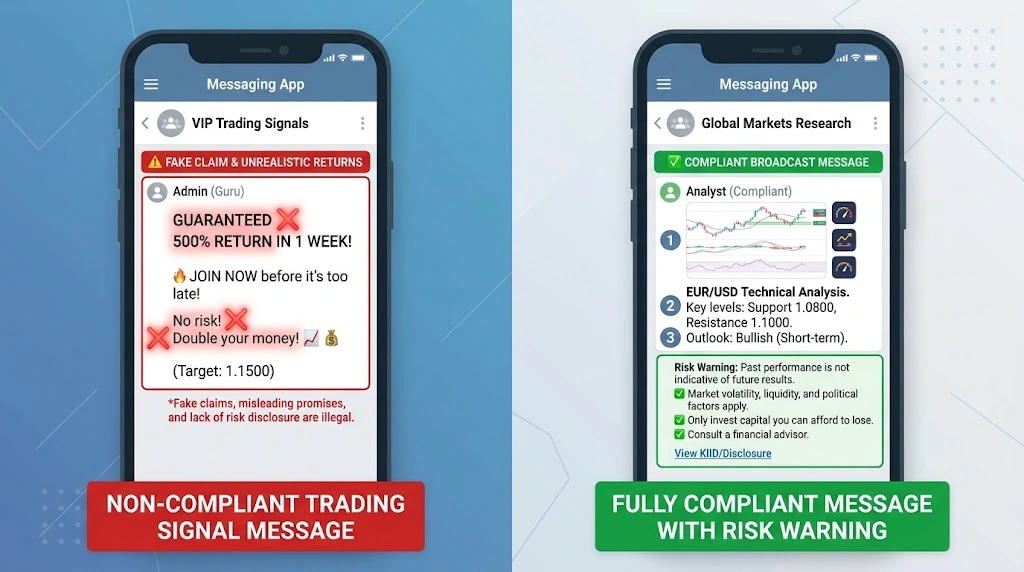
- A clear, visible risk warning stating that trading crypto assets involves substantial risk of loss.
- Clear identification of the legal entity behind the channel, where one exists.
- Disclosure of any paid partnership, sponsorship, or affiliate relationship tied to a signal or recommendation.
What You Can’t Claim
- Guaranteed returns or fixed income promises. Phrases like “guaranteed 20% monthly” are exactly what regulators flag first. In fact these absurd guarantees are exactly what educated traders look for when they want to spot a fake or scam forex signals channel on Telegram and regulators apply the exact same logic to crypto groups.
- APY or yield figures presented without the accompanying risk context.
- Bonus structures or promotional offers designed to mislead new subscribers about the actual cost or risk of joining.
Fines for marketing and disclosure violations under MiCA can run up to 5% of annual turnover or EUR 5 million, whichever figure is higher. That’s not a number aimed at small Telegram channels specifically, but it reflects how seriously EU regulators are treating promotional content around crypto right now, and enforcement pressure tends to flow downward over time.
A Practical Compliance Checklist for Signal Group Admins
Run through this before you touch anything else in your channel setup:
- Separate your content types. Keep forex and crypto signals clearly labeled, since they answer to different regulations entirely. If scaling your community makes manual separation difficult you can always manage forex VIP clients with a Telegram AI bot to ensure clean boundaries between your crypto calls and traditional finance channels.
- Audit your VIP tier. If it involves any degree of personalization, treat it as a potential advice service and get jurisdiction specific legal input.
- Add a standing risk disclosure to your channel description and pin it where new members will see it immediately.
- Remove guaranteed return language from your channel bio, pinned posts, and any promotional creatives you run.
- Check the ESMA register if you’re operating, or plan to operate, as anything resembling a licensed crypto service, since only authorized providers appear there.
- Document your decisions. If you’ve deliberately structured your service to stay broadcast only and avoid the advice perimeter, keep a written record of why, in case a regulator or platform ever asks.
- Review your affiliate and sponsorship disclosures so paid placements are clearly marked as such, not blended into organic looking signals. Administrators of mixed communities should also review how to legally share forex affiliate links on Telegram since promotional rules apply strictly to both cryptocurrency exchanges and traditional brokers.
What Happens If You’re Not Compliant
Since the grandfathering period closed on July 1, 2026, national competent authorities across the EU have been instructed to pursue enforcement against unauthorized providers rather than treat the gap as a transitional courtesy. For a signal group, the realistic risks aren’t limited to formal licensing action. They include payment processor and platform level scrutiny, subscriber complaints escalating to a regulator, and reputational damage once a channel gets flagged publicly for misleading claims. None of that requires a full scale enforcement case to hurt your business. A single complaint tied to a guaranteed return claim can trigger a review long before any license question comes into play.
“The transition period closing means supervisory authorities are actively shifting their focus from major exchanges directly toward retail influence and social media trading communities. Channel operators must understand that administrative fines for market manipulation under the new framework can reach up to fifteen million Euros or fifteen percent of total annual turnover for legal entities. Pleading ignorance about audience location or trying to hide behind generic disclaimers while offering automated portfolio management is no longer a viable defense.”
Julian Vance, Senior Digital Asset Compliance Advisor
FAQ: MiCA Compliance Guide for Telegram Forex
Does MiCA apply to Telegram trading signal channels?
It can, but only when the channel is giving personalized recommendations rather than posting the same signal publicly to everyone. Broadcast style channels generally sit outside MiCA’s advice definition.
Is giving crypto trading signals considered advice under MiCA?
It depends on how the signal is delivered. ESMA’s own guidance treats personalized, one to one recommendations as advice, while identical messages sent to an entire subscriber base are treated more like public commentary.
Do I need a CASP license to run a paid signal group?
Not automatically. A paid subscription alone doesn’t trigger licensing. What matters is whether the paid tier includes tailored recommendations based on an individual member’s circumstances.
Does MiCA cover forex signals too?
No. Forex and CFD signals fall under MiFID II, a separate EU framework with its own leverage limits and advice restrictions. MiCA is limited to crypto assets specifically.
What happens if my signal group isn’t MiCA compliant?
Beyond formal enforcement risk from national regulators, non compliant channels face payment processor scrutiny, subscriber complaints, and reputational fallout, particularly around unsubstantiated return claims.
What disclaimers does a crypto signal channel need in the EU?
At minimum, a clear risk warning about the possibility of losing money, transparent identification of who’s behind the channel, and disclosure of any paid or affiliate relationships tied to specific signals.
Final Word
MiCA compliance for a Telegram crypto signal group comes down to structure more than intent. Keep your signals broadcast based, keep your disclosures visible, and keep forex and crypto content clearly separated as outlined in this MiCA Compliance Guide for Telegram Forex, and you’ll be operating well within the boundaries most regulators actually care about. The moment personalization becomes part of your business model, that’s the moment to bring in someone who can look at your specific setup and tell you whether a license is genuinely on the table.
If you want help reviewing how your channel is structured or setting up compliant VIP tiers, reach out to our team on Telegram at @membertelsupport.











Leave a Reply