

Yes, it is legal to share a forex broker’s affiliate link on Telegram in the EU, as long as the broker is properly regulated, your promotion is fair and not misleading, and you disclose that you earn a commission. The trouble starts when any one of those three conditions is missing, and most admins never find out which one they broke until a regulator or a payment processor already noticed.
That answer sounds simple, but the details underneath it are where admins actually get burned. Forex Telegram channels have exploded across Europe over the past few years, and regulators have noticed the pattern too. In May 2025, the European Securities and Markets Authority sent an official letter to Telegram itself, asking the platform to help curb unauthorised financial advertising spreading through its channels and groups. That letter did not target one rogue admin. It targeted the entire ecosystem of forex and crypto promotion running through group chats, and it signals where enforcement attention is heading next.
Why Regulators Are Suddenly Watching Telegram Forex Channels
Forex signal groups used to fly under the radar. Most regulators focused on the brokers themselves, since brokers hold the licence and the client money. That focus has shifted, and Telegram is a big part of why.
Understanding exactly why are forex ads rejected on Meta helps explain this massive platform migration. Since strict advertising policies on traditional social networks forced promoters to find alternatives learning how to grow a forex Telegram channel without Meta ads became a necessary survival skill for affiliates which naturally led to the massive influx of channels that European authorities are now investigating.
The ESMA Letter to Telegram
ESMA’s letter was addressed to Telegram directly, not to a specific channel or admin, and it was written on behalf of ESMA along with the national competent authorities of all 27 EU member states. The letter described a rise in fraudulent actors using digital platforms to advertise financial services they were never authorised to offer, and it referenced a related initiative from the International Organization of Securities Commissions on the same problem.
What matters for a channel admin here is not the letter’s wording. It is what the letter represents: coordinated attention from every national regulator in the EU, aimed squarely at the platform your channel lives on.
FCA’s Finfluencer Prosecutions
The UK sits outside the EU now, but its enforcement pattern is the clearest preview of where EU regulators are headed. The FCA charged nine people for promoting an unauthorised foreign exchange trading scheme through social media, all tied to a campaign that ran between 2018 and 2021. The people charged were not just the original promoters. Several were influencers paid to repost the account to their own followers, and each one faces a charge for issuing unauthorised financial promotions, an offence that carries a fine and up to two years in prison.
That detail is the part admins tend to skip past. You do not need to run the scheme to be charged. Amplifying it to your own audience is enough.
Are You a Financial Promotion, Even If You’re Just an Affiliate?
Most admins assume a financial promotion is something only a broker’s marketing team produces. That assumption is wrong under EU and UK rules, and it is the single biggest source of accidental risk in this space.
The FCA’s own guidance on social media financial promotions states that the rules are platform agnostic. They apply the same way whether the content sits in a paid ad, an Instagram story, or a message in a Telegram chatroom. A meme counts. A pinned message counts. A signal post with your referral link at the bottom counts.
Why “I’m Just Sharing a Link” Isn’t a Legal Shield
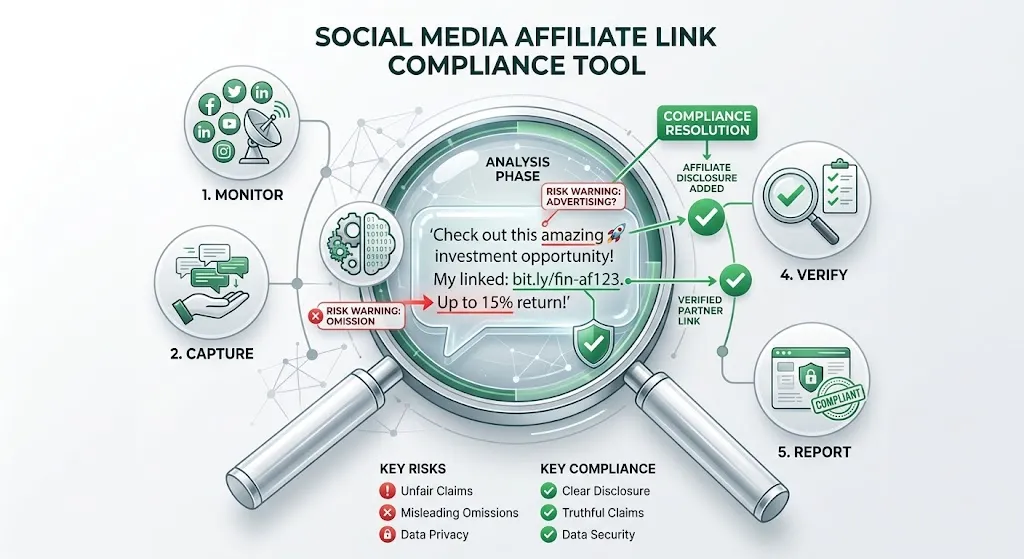
Here is where it gets messy for a lot of admins. If your affiliate link is attached to a post, the post becomes a financial promotion, and financial promotions have to be fair, clear, and not misleading. That standard doesn’t care whether you personally wrote the broker’s claims or copied them from a promotional pack the broker sent you. If the copy overstates returns or downplays risk, you are the one distributing it to your specific audience.
When Signal Sharing Crosses Into Investment Advice
This is the line that trips up the most active channels. Posting a chart with “resistance around 1.0850, worth watching” is commentary. Posting “buy EUR/USD now, target 1.0920, this is a guaranteed setup” edges toward investment advice, and investment advice requires authorisation in every EU member state. ESMA’s own commentary on affiliate activity has noted that affiliates have, on multiple occasions, ended up providing what amounts to investment advice or money management services without holding the licence to do so. Brokers are expected to supervise their affiliates for exactly this reason, which means your broker’s compliance team may already be watching how you phrase your signals.
As compliance expert Dr Julian Vance who advises European brokerages on affiliate networks points out the speed of the platform is its biggest liability. We audited over four hundred financial Telegram channels last year and nearly eighty percent failed basic MiFID II inducement tests Vance explains. Admins treat Telegram like a private conversation with friends forgetting that dropping an affiliate link instantly transforms that chat into a regulated commercial environment. A simple word like Ad or Sponsored at the top of the message could have saved half of them from regulatory warnings.
What ESMA and National Regulators Actually Require
The legal framework here isn’t a single rulebook. It is a layer of EU wide standards sitting on top of whatever your own country’s regulator adds locally.
Beyond just financial promotions anyone targeting European audiences must also consider broader data privacy laws. A common concern among compliance officers is whether or not is Telegram GDPR compliant since handling European subscriber data improperly can invite massive penalties entirely separate from trading and financial regulations.
MiFID II Inducement Disclosure Basics
Under MiFID II, any commission, fee, or non monetary benefit paid in connection with an investment or ancillary service counts as an inducement, and inducements have to be disclosed before the service is provided, in a way that is fair, clear, and not misleading. An affiliate commission from a forex broker fits that definition. The disclosure obligation does not disappear just because you are a solo Telegram admin instead of a registered investment firm; it sits on the broker’s compliance framework, and the broker’s framework is supposed to extend down to you.
Mandatory Risk Warnings
CFD and leveraged forex products carry a standardised risk warning requirement across ESMA, FCA, and ASIC regimes: the promotion has to state the percentage of retail accounts that lose money trading that product. Brokers usually supply this line as part of their compliant creative packs. If you strip it out of a post because it looks cluttered or “kills the vibe,” you have just removed the one line that made the post compliant.
Why the Rules Follow the Trader, Not You
A detail that surprises a lot of admins: it doesn’t matter where you personally live. What matters is where your audience is based. A Telegram channel run by an admin in Dubai, promoting a broker to subscribers who are mostly in Germany and Poland, still triggers EU rules, because those rules protect the retail client, not the promoter. National regulators are specifically encouraged to supervise brokers operating in their territory even when the broker is licensed somewhere else in the EU.
When your Telegram channel is open to the public anyone from any country can join. This creates a compliance nightmare because a post that is perfectly legal for a follower in Brazil might violate strict regulations for a follower reading the exact same message in France. Regulators expect you to manage this overlap. The most compliant approach is to use Telegram channel restriction settings to geo block users from regions where your partner broker is not licensed or to run separate region specific channels. If you cannot restrict access your mandatory risk warnings and disclosures must meet the standards of the strictest jurisdiction your audience resides in.
| Regulator | Applies to | Core requirement for affiliates |
|---|---|---|
| ESMA / MiFID II | All EU member states | Inducement disclosure, fair and clear promotion |
| FCA | United Kingdom | Financial promotion rules apply regardless of platform |
| CySEC | Cyprus, widely used broker licence | Pre approved promotional templates for affiliates |
| National competent authority | Wherever your audience lives | Local enforcement of the above, even against foreign brokers |
The Compliance Checklist for Telegram Admins
This is the part most compliance guides skip, because most of them are written for the broker’s legal team, not for the person actually posting in the channel.
What to Put in Your Channel Bio or Pinned Message
- State plainly that you earn a commission when someone signs up through your links
- Name the broker or brokers you work with, rather than leaving it vague
- Include a short risk statement, since trading forex and CFDs carries a high risk of losing money
- Avoid the word “guaranteed” anywhere near the word “profit,” in the bio or anywhere else
What to Repeat on Every Affiliate Post
- A one line disclosure close to the link itself, not buried in a pinned message nobody reopens
- The broker’s regulatory status, if you know it (for example, “CySEC regulated”)
- No performance claims you cannot back with a verifiable source
Red Flags That Attract Regulator Attention
Certain phrases act like a magnet for scrutiny, and they show up constantly in low effort forex channels: guaranteed returns, risk free trading, insider signals, or anything implying a fixed monthly payout.As you brainstorm proven content ideas for forex Telegram channels it is absolutely vital to keep all promotional claims realistic and verifiable.
To maintain this regulatory standard efficiently many large communities choose to manage forex VIP clients with a Telegram AI bot configured to monitor incoming posts and automatically block exaggerated financial promises or prohibited keywords. A well run channel bot can filter these terms out automatically before a post ever goes live, which is a far more reliable safeguard than trusting every contributor to self police their own language.
Your Personal Liability vs. the Broker’s Liability
This is where the commercial side of the question comes in, because plenty of admins reading this are trying to decide which broker’s affiliate program to actually join.
Can You Be Held Responsible If the Broker Is Unregulated?
Short answer, yes, and this is the riskiest gap in the whole ecosystem. Under FCA guidance, a firm is liable for the compliance of any promotion made by its affiliates, and that liability runs both ways in practice. If the firm’s referral link sits on your post, the firm is on the hook for what you wrote. But if the firm itself was never authorised to begin with, there is no compliant framework protecting you either, and you are the one directly distributing an unauthorised financial promotion to your own audience.
Regulators also pay close attention to how you are getting paid. Affiliate agreements usually fall into two categories which are Cost Per Acquisition where you get a flat fee for a sign up and Revenue Share where you earn a percentage of the trader volume or losses. Revenue share models face intense regulatory scrutiny in the EU because they create a direct conflict of interest. If you earn more money when your followers lose trades any signal or market commentary you post will be viewed through that lens.
Many European regulators consider revenue share models targeting retail clients to be an aggressive inducement so choosing a flat fee structure often provides a safer legal foundation for your channel.
Impersonation scams add another layer here. Fraudulent Telegram groups have posed as legitimate companies entirely unrelated to trading, using stolen branding and fake testimonials to solicit funds from group members. Once a channel gets a reputation for pushing sketchy offers, subscribers start assuming every link in it is a scam, which kills conversion rates faster than any regulator ever could.
Because modern retail traders are actively educating themselves on how to spot a fake or scam forex signals channel on Telegram maintaining absolute transparency regarding your broker partnerships is the only reliable way to keep your audience engaged and trusting your content over the long term.
What to Check Before Promoting Any Broker
- Look up the broker’s licence number directly on the regulator’s public register, not on the broker’s own site
- Confirm the commission structure is stated plainly in the affiliate agreement, not described as “up to” a headline percentage with no floor
- Check whether the affiliate program provides pre approved, compliance flagged promotional material, since that shifts real risk off your shoulders
- Walk away from any program that pressures you to remove risk warnings because they “hurt conversion”
FAQ
Is forex affiliate marketing legal in the EU?
Yes. It is a recognised, common practice across EU brokers, provided the promotion is fair, clear, not misleading, and discloses the commission relationship.
Do I need a licence to share a broker referral link on Telegram?
No licence is required to share a link. A licence becomes necessary the moment your content shifts from sharing a link into giving personalised investment advice or portfolio guidance.
What is an unauthorised financial promotion?
It is any communication promoting a financial product or service that hasn’t gone through the approval of an authorised firm, or that comes from a person who isn’t licensed to make that kind of promotion in the first place.
Can a Telegram admin be held personally liable for a broker’s marketing claims?
Yes, particularly if the admin actively rewrote or amplified misleading claims rather than passing along broker approved material. Distributing a promotion to your own audience carries its own responsibility, separate from whatever the broker is liable for.
What did ESMA’s letter to Telegram actually say?
It asked Telegram to help address the spread of unauthorised financial advertising on the platform, written jointly on behalf of ESMA and the national regulators of all 27 EU member states.
What disclosures should an EU forex affiliate include in every post?
A plain statement that the link earns a commission, the broker’s name and regulatory status where known, and the standard retail loss risk warning required for CFD and leveraged products.
Closing Thoughts: Legal to Share a Forex Broker’s Affiliate Link on Telegram
Running a forex Telegram channel in Europe is not illegal and neither is putting an IB link at the bottom of your posts. What actually creates legal exposure is treating the promotion as separate from everything else you post around it. While it is legal to share a forex broker’s affiliate link on Telegram in the EU the rules governing CFD promotion follow the content rather than the platform. Telegram has moved from a grey zone into a space regulators are actively watching. A short disclosure line an honest description of the risk and a broker whose licence you have actually checked will cover most of what ESMA and your national regulator expect from you.
If you need assistance setting up secure bots managing your trading community or ensuring your channel infrastructure is running efficiently reach out to our team at @membertelsupport and let us help you professionalize your Telegram operations.













Leave a Reply