

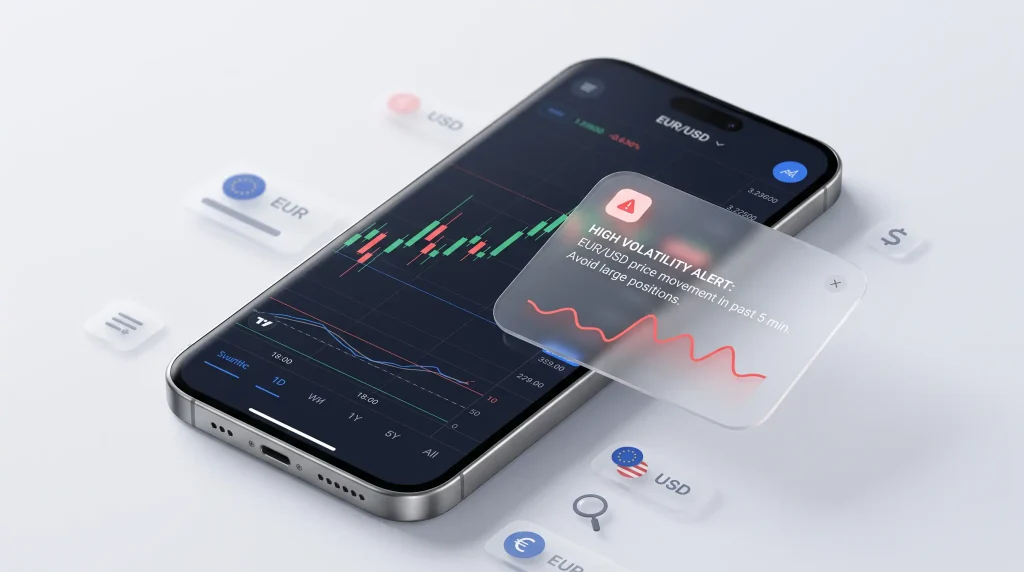
Why are forex ads rejected on Meta? Because forex and CFD trading fall under Meta’s financial products policy, and any ad missing licensing proof, making profit promises, or leaving out a risk warning gets caught by automated review before a human ever sees it. That single sentence covers most of what goes wrong. The rest of this guide breaks down each cause on its own, shows why a rejected ad and a restricted account are two very different problems, and hands you a checklist to actually get campaigns approved and keep them running.
Key Takeaways
- Forex advertising on Meta is restricted, not banned, but CFD trading itself is fully prohibited regardless of how the ad is written.
- A rejected ad and a restricted Business Manager are separate problems. Fixing the ad does not automatically protect the account.
- No business identity verification and no regulatory authorization means automatic rejection, even for a perfectly written ad.
- Guaranteed return language gets caught even when it comes from a client testimonial instead of the advertiser directly.
- A new ad account that scales its budget too fast is one of the fastest ways to get restricted within the first few days.
Why Meta Treats Forex Ads as a Restricted Category
Forex trading sits in the same bucket as loans, insurance, and crypto inside Meta’s advertising rules. That bucket exists because financial products carry real consumer risk, and regulators in dozens of countries hold platforms partly responsible for what gets promoted on them. Meta’s review system does not read intent. It reads patterns. A well meaning broker writing about spreads and a scam operation promising guaranteed profits can trigger the exact same automated flag, because the system is tuned to catch language and imagery first, then sort out context later through appeals.
Enforcement in 2026 also runs on a multimodal AI model. It scans ad copy, checks images and video frames for banned visual cues, and watches account behavior such as sudden budget jumps or logins from unfamiliar locations. A softened version of a banned claim, like swapping “guaranteed profit” for “reliable returns,” is still caught, because the model is trained on meaning, not exact wording.
The Real Reasons Forex Ads Are Rejected on Meta
Most rejections trace back to a small set of repeat offenders. Understanding each one is the fastest way to stop losing ad accounts.
Missing Financial Services Authorization
Meta requires advertisers promoting financial products to verify their business identity and, in many markets, demonstrate authorization from the relevant regulator before an ad can run. This is a two stage process. Meta first confirms who you are, then checks whether you are licensed to offer the product in each country you target. Skipping this step is one of the most common and most avoidable causes of rejection, and Meta reserves the right to review that authorization on an ongoing basis, not just once at signup.
Independent affiliate marketers and introducing brokers face an even steeper climb here. The platform requires the ad account owner to hold the actual regulatory license. If you are an affiliate trying to promote a regulated broker using your own personal business manager the system will likely suspend you because your verified business details do not match the financial license. The only compliant path for affiliates is to run campaigns through the main broker account using partner permissions or to focus entirely on broad educational content that never links directly to a trading signup page.
Prohibited Claims and Unrealistic Promises
Any copy suggesting guaranteed returns, risk free trading, or a specific profit figure (“earn 5,000 euros a month”) violates Meta’s financial products policy in every region, regardless of whether the claim is technically true for some clients. The safer approach is to write about verifiable features: regulation, spreads, platform tools, and educational content, rather than outcomes.
CFD and Other Prohibited Instruments
This is where many advertisers get caught off guard. Meta categorizes complex financial derivative products differently than standard spot trading. While binary options are permanently prohibited under any framing promoting Contract for Difference trading requires navigating an extra layer of bureaucracy. You cannot simply launch a CFD campaign even if you hold a valid local regulatory license. Advertisers must obtain explicit prior written permission directly from Meta to promote these specific instruments. This involves submitting a formal onboarding request to prove your regulatory standing. Without this direct platform approval in place beforehand attempting to run derivative campaigns will result in automatic failures.
Missing or Incomplete Risk Disclaimers
Regulated markets expect a visible, legible risk warning in the ad creative itself, not buried on the landing page. Meta requires forex advertisers in certain countries, including Australia, India, and Taiwan, to include specific disclaimers before a campaign can go live, and some jurisdictions require a “Paid for by” disclosure naming who is funding and benefiting from the ad.
Misleading Visuals or Disruptive Creative
Images or video that borrow a public figure’s likeness to imply endorsement, simulate a trading platform interface, or use flashing screen effects are rejected on sight. Meta’s automated review scans frame by frame, so a single flagged second in a fifteen second video is enough to sink the whole ad.
The Landing Page Trap
The review process does not stop at your ad creative. Meta deploys automated crawlers to scan your destination link the moment you submit a campaign. If your ad copy is perfectly clean but your website features a massive headline promising daily returns or lacks required regulatory footers the campaign will be rejected instantly. Your landing page must act as an extension of the ad itself and maintain the exact same professional tone. Trying to outsmart this process by using cloaking software to show reviewers a safe page while redirecting real users to a non compliant offer leads to an immediate and permanent business manager ban.
Risky Account Behavior
Rejection is not only about the ad itself. Meta’s 2026 review model also scores account behavior. Scaling a daily budget aggressively right after launch, logging in from many unfamiliar devices, linking to a Business Manager with a prior violation history, or unusual billing patterns can all raise the account’s risk score, sometimes without a single word of the ad copy changing.
Launching Too Fast on a Brand New Account
New forex ad accounts get judged more harshly in their first days than established ones, even with identical creative. An account with no spend history that jumps straight to a large daily budget looks statistically similar to accounts used for fraud, so Meta’s system watches it closely. Media buyers in the forex space generally recommend a slow start: modest budgets for the first week or two, then gradual increases, rather than launching at full spend on day one. Skipping this warm up period is a frequent reason brand new accounts get restricted within their first 72 hours, often before the team even finds out what triggered it.
Testimonials That Imply Guaranteed Results
A trader saying “I made 3,000 dollars in my first month” feels harmless because it is a real quote, but Meta treats testimonial driven return claims the same as a direct promise from the advertiser, especially in markets with strict retail trading protections. If you use client testimonials, keep them focused on service quality, platform experience, or support, and strip out any specific dollar figures or win rate percentages.
Age Targeting and Special Ad Category Errors
Financial products ads must target people 18 or older, and in the US, Canada, and parts of Europe, advertisers must self identify under Meta’s Special Ad Category for financial products before targeting options become available. Forgetting this step, or selecting the wrong category, is a quiet but frequent cause of disapproval.
The Proprietary Trading Firm Gray Area
Proprietary trading firms have recently taken over the retail forex space and many media buyers mistakenly assume these evaluation accounts bypass standard financial rules because they do not handle client funds directly. Meta review systems do not see it that way. The algorithm treats funded account challenges with the same strict scrutiny as traditional brokerages. If your campaign promises guaranteed evaluation passes easy payouts or fast funding it will be flagged for making unrealistic financial claims. The most stable approach for prop firm advertising is to market the service purely as an educational challenge or a simulated trading evaluation carefully avoiding any language that implies a clear path to sudden wealth.
Prohibited vs Restricted: What Meta Actually Allows
| Status | Product or Practice | What This Means |
|---|---|---|
| Fully prohibited | CFD trading, binary options, ICOs, penny auctions | Cannot be advertised under any framing |
| Restricted, needs authorization | Standard forex trading, brokerage accounts, managed portfolios | Requires identity verification and, in many markets, a regulator license |
| Restricted, needs disclosure | Ads targeting Australia, India, Taiwan and similar markets | Requires a visible risk warning or “Paid for by” disclaimer |
| Always banned regardless of category | Guaranteed return claims, risk free promises, celebrity bait imagery | Rejected on content alone, independent of licensing status |
Ad Rejection vs Account Restriction: Why the Difference Matters
Most advertisers focus entirely on getting one ad approved and overlook a bigger risk. A single rejected ad is a minor setback you can usually fix and resubmit within a day. An account restriction is a different problem entirely. When Meta’s system flags a pattern of violations, or judges the account’s overall behavior as risky, it can disable the entire Business Manager, not just the offending ad. Recovering a restricted forex ad account is slow, the appeal process often takes days or weeks with limited human review, and in some cases the restriction becomes permanent.
Treating every campaign as if the whole account depends on it is not an exaggeration. It is the accurate way to think about forex advertising on Meta in 2026. A brand that fixes one bad ad but keeps scaling budget aggressively or reusing a flagged Business Manager is still at risk, even with perfectly compliant copy.
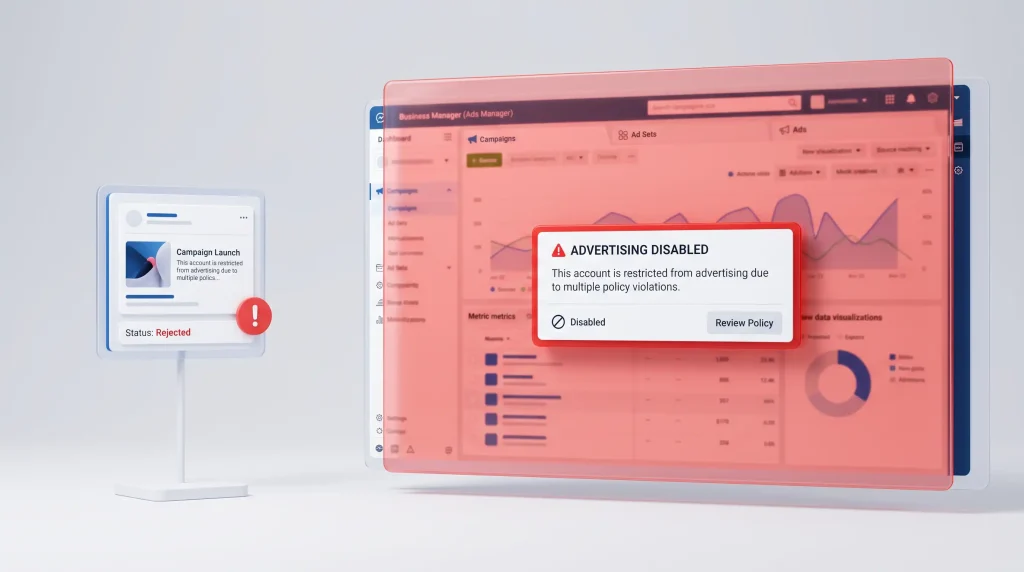
“People assume a rejection notice means the ad had a problem, so they rewrite the ad and move on,” says Daniyar Rustam, a paid social compliance consultant who works with regulated brokers. “In finance verticals the account itself is what’s being scored. Meta’s own transparency reporting shows its review teams acted on more than a billion ads globally in a single year for policy violations, and financial services sits near the top of that enforcement list because the abuse rate is so high. Once an account crosses a certain risk threshold, it doesn’t matter how clean the next ad is.”
That scale of enforcement is exactly why forex advertisers cannot treat compliance as a copywriting task. It is an account management discipline.
“Most media buyers obsess over finding the perfect combination of words to bypass the review system but they completely ignore their operational infrastructure,” notes Marcus Thorne a compliance director managing large budgets for regulated brokers. “In our latest internal audit we found that nearly seventy percent of ad account restrictions in the forex vertical were triggered by destination URL violations and budget velocity rather than actual ad copy violations. Meta evaluates the entire ecosystem from the first click to the final website footer.”
Country Specific Disclosure Requirements
| Country or Region | Requirement |
|---|---|
| Australia | Risk warning and “Paid for by” disclaimer required in the ad |
| India | “Paid for by” disclaimer naming the funding entity |
| Taiwan | “Paid for by” disclaimer required before the campaign can launch |
| United States | Special Ad Category self identification required for financial products |
| European Union markets | Regulator authorization proof required per country targeted, no single EU wide pass |
These requirements are set and updated by Meta and by local regulators, so always confirm the current version in Meta’s Business Help Center before launch, since disclosure rules are adjusted more often than the core ad policy.
How to Fix a Rejected Forex Ad and Resubmit It
- Read the exact rejection reason in Ads Manager rather than guessing. Meta usually names the specific policy that was triggered.
- Remove any language implying guaranteed, risk free, or specific profit outcomes, and reword around features and education instead.
- Add a visible risk warning inside the creative, matching the wording required in the targeted country.
- Replace any flagged image or video, especially ones using face based bait, simulated trading dashboards, or flashing effects.
- Confirm your Special Ad Category selection matches the product being advertised.
- Check that your business identity verification and regulatory authorization are current and cover the specific country and product type.
- Resubmit as a single, clean edit. Submitting many near identical variations at once looks like spam behavior and can trigger a deeper account review instead of a quick approval.
- If you believe the rejection was a mistake, use the appeal option inside Ads Manager rather than creating a new ad from scratch. Appeals keep the review tied to your account’s existing history, while a brand new duplicate ad can look like an attempt to dodge the original decision.
Pre Launch Compliance Checklist for Forex Ads on Meta
- Business identity verification is complete.
- Regulatory authorization is current for every country targeted.
- No guaranteed return, risk free, or specific profit language anywhere in the copy.
- A legible risk warning appears in the creative itself.
- Images and video contain no celebrity likeness, fake platform screens, or flashing effects.
- Targeting is set to 18 and older, with the correct Special Ad Category selected.
- The landing page matches the ad’s claims and carries its own risk disclosure.
- Budget scaling is gradual, and the account has no history of linked violations.
A Realistic Scenario
A mid sized brokerage launches a campaign promoting a new trading app. The copy avoids profit claims and focuses on the platform’s charting tools, which passes review easily. Two weeks later, the same Business Manager gets flagged, not for that ad, but because the team doubled the daily budget overnight after a strong first week and added a new admin who logged in from three countries within 48 hours. Meta’s account level review restricts ad delivery pending manual verification, even though every live ad was fully compliant. The lesson here is simple: content compliance and account behavior are two separate systems, and both need attention.
Where to Turn When Meta Isn’t an Option: Telegram as a Compliant Alternative Channel
Because forex and CFD promotion is so tightly restricted on Meta, many brokers and trading educators are shifting part of their audience building to Telegram. A Telegram channel or group does not face the same automated ad review, which makes it a practical space for market commentary, trade signals, and community discussion that would get rejected as a Meta ad.
This does not remove the need for honest disclosures and proper licensing, regulators care about the message regardless of platform, but it gives brokers a direct line to an engaged trading audience without fighting Meta’s review system for every post. A common approach is to use Meta ads for broad awareness with fully compliant, feature focused copy, and drive interested users toward a Telegram community where deeper trading content, signals, and market analysis can be shared more freely.
Building a generalized audience is a good starting point but regional focus consistently yields higher engagement and better conversion rates. For example studying the structure of the Best Telegram Trading Community in the Netherlands provides brokers with a localized blueprint of how retail traders share market analysis and interact with daily signals. This highly targeted approach keeps your growing audience active and loyal without running into the broad automated restrictions that plague traditional advertising platforms.
Once you establish your private channel managing the influx of user interactions and trade executions becomes the next major operational challenge. Many successful financial firms deploy Telegram Trading Bots to broadcast instant market updates and handle repetitive technical queries directly within the chat interface. This automated approach ensures clients receive immediate compliant responses without requiring a massive human team monitoring the group around the clock.
Frequently Asked Questions
Can I run forex ads on Meta at all?
Yes, but only for standard forex trading and brokerage products, and only after completing business verification and regulatory authorization. CFD trading itself is prohibited outright.
Does Meta allow CFD advertising?
No. Contract for Difference trading is on Meta’s list of fully prohibited financial products, regardless of how the ad is written.
What happens if my forex ad account gets restricted?
Meta can pause ad delivery or disable the entire Business Manager. Recovery depends on Meta’s appeal review, which can take days to weeks, and repeated violations make a permanent restriction more likely.
Do I need a license to advertise forex on Meta?
In most markets, yes. Meta requires proof of authorization from the relevant financial regulator in each country you target, and there is no single license that covers every market at once.
How long does Meta’s review take for financial services ads?
Standard review is usually completed within 24 hours, but financial category ads often take longer because of the added authorization and disclosure checks, and appeals after a rejection can take several additional days.
Final Takeaway
Getting past ad review is only half the job. The advertisers who consistently succeed treat licensing, disclosures, and account behavior as one connected system rather than a one time checklist. So when you are asking why are forex ads rejected on Meta, the honest answer is that it is rarely a single mistake. It is usually a combination of missing authorization, risky language, and account habits that Meta’s AI is specifically built to catch. Fix all three together, and your forex campaigns stand a real chance of staying live.














Leave a Reply