
Dunning management for creators is the process of catching a failed subscription charge before it turns into a lost subscriber, using automatic retries, clear communication, and controlled access so the member has a real chance to fix the payment instead of just disappearing. If you run a paid Telegram channel, a Discord server with paid roles, or a community where followers buy Telegram Stars for exclusive access, this is the system that decides whether a declined payment becomes a recovered subscription or a quiet cancellation.
Most creators only notice payment failures when their monthly revenue dips and they cannot explain why. The truth is usually boring: a card expired, a bank flagged the charge, or an app store token went stale. None of that means the subscriber wanted to leave.
The most effective way to handle a failed payment is to stop it from happening in the first place. This proactive approach is known as pre dunning and it focuses on predicting failures before a renewal date arrives. Credit cards expire on a predictable schedule so your billing system can automatically send a polite heads up to members two weeks before their card expires. Many modern payment processors also provide account updater services which automatically fetch new card details directly from the banking network when a subscriber gets a replacement card in the mail. Turning these features on ensures you keep the recurring revenue without your members experiencing any disruption in their access.
Why Payments Actually Fail
A failed charge is not a single problem. Payment processors return a decline code, and that code tells you whether repeating the exact same charge is worth trying or a waste of everyone’s time.
| Decline type | Common cause | Best response |
|---|---|---|
| Insufficient funds | Card has no available balance right now | Retry 3 to 5 days later, ideally near the 1st or 15th of the month |
| Card expired | Subscriber’s card is past its expiry date | Send an update link, retrying will not help |
| Issuer unavailable | Bank system temporarily down | Retry within 4 to 24 hours |
| Processing error | Gateway or network glitch on either side | Retry within 24 to 48 hours |
| Hard decline | Card reported lost, stolen, or closed | No retry, request a new payment method |
| Fraud flag | Bank’s fraud system blocked the charge | No retry, subscriber needs to contact their bank or update payment method |
This is the part most default subscription tools get wrong. They treat every failure the same way and just repeat the charge a few days later, which works fine for insufficient funds but does nothing for an expired card or a closed account. Recovering failed subscription payments effectively means matching the retry logic to the actual reason the charge failed, not running one generic sequence for everything.
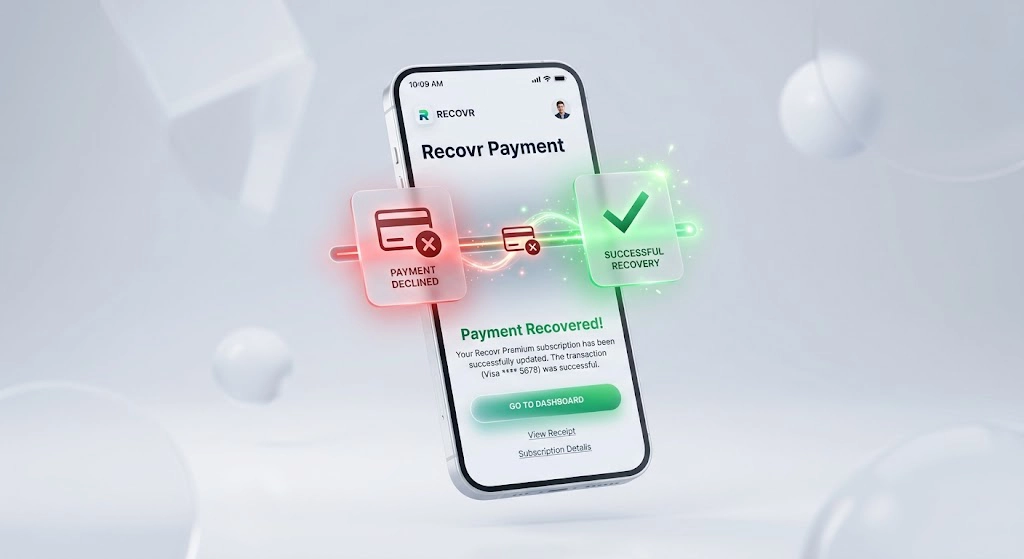
Recover Failed Subscription Payments: Building the Retry Schedule
The first line of defense in any dunning setup is automatic retries, and this is where creators can recover a meaningful chunk of failed revenue without sending a single message.
Choosing the right billing infrastructure is crucial. If you are currently exploring the Best Payment Solutions for Telegram Sellers remember that your choice directly dictates how you handle a failed transaction. For instance relying on dedicated Telegram Payment Bots often gives you direct control over sending automated renewal reminders right in the chat before a permanent drop happens.
Stripe
If you bill through Stripe, open Billing, then Revenue recovery, then Retries. Smart Retries uses Stripe’s own model to pick retry timing based on the decline reason and card network, which generally outperforms a flat schedule. This only applies to renewal invoices on an existing subscription. A failed first time checkout is a different problem and needs a fresh attempt from the customer, not a retry.
PayPal
PayPal subscriptions behave differently because PayPal itself controls the retry attempts once a recurring payment is set up. What a creator controls is the grace period around those attempts, meaning how long access continues while PayPal keeps trying, how many attempts happen before the subscription is treated as failed, and what happens to the member’s access at each stage.
Telegram Stars
This is the piece almost every generic dunning guide skips entirely, because Stars is unique to Telegram. Since a Stars subscription is billed inside Telegram itself rather than through a card processor a creator controls directly, the retry logic sits with Telegram, not with the creator’s own system. What the creator can still control is the messaging around it and how quickly they flag an inactive Stars subscription so a win back offer goes out instead of the member just fading away unnoticed.
Since Telegram handles the actual card processing you cannot force a retry yourself. However you can track exactly when a user loses their premium status or their star subscription lapses. Your community bot should immediately detect this status change and automatically send a personalized direct message offering a quick link to resubscribe before they forget about the channel entirely.
Most successful retry sequences run 4 to 8 attempts spread across 15 to 30 days. Going longer than that rarely helps and starts to look suspicious to fraud systems at the issuing bank, which can make the situation worse rather than better.
Talking to Members Without Sounding Like a Collections Notice
Automatic retries alone will not tell a subscriber why they lost access, and silence is the fastest way to turn a fixable card problem into a permanent cancellation.
A message that actually gets acted on does three things: it names the specific plan affected, it tells the person exactly where to fix it, and it says what happens to their access if they do nothing. Vague language like “there was an issue with your payment” makes people assume it is spam and ignore it.
Many community builders feel anxious about sending payment reminders because they worry about coming across as greedy or annoying to their audience. You have to reframe how you view this interaction. You are providing a valuable service they actively signed up to receive and a gentle reminder is simply good customer support. You are helping them maintain access to a community they enjoy rather than harassing them for money. Shifting any blame away from the subscriber and placing it entirely on the technology makes them feel supported instead of targeted.
For Telegram creators using broadcast tools, a working sequence looks like this:
Day 1, right after the failure A short, calm heads up. Name the plan, state that a retry is scheduled, link to where they can check their status.
Day 3, if still unresolved A slightly more direct nudge that includes the update link front and center, not buried in a paragraph.
Day 7, final notice Clear language that access ends on a specific date if nothing changes, plus one more link to fix it.
Testing subject lines and message framing matters more than most creators expect. A direct line like “Your payment did not go through” tends to get opened faster than a softer version, but tone should still match your brand voice. What should never change is clarity: no guessing games about what actually happened.
Beyond just having the right tone the process of actually fixing the payment must be completely frictionless. If a member clicks the update link and is forced to remember a password log in navigate to account settings and find a hidden billing tab they will likely give up halfway through. Every extra click reduces your final recovery rate. Always use direct secure hosted update links provided by your payment processor so the subscriber can enter their new card details in less than ten seconds or use digital wallets like Apple Pay and Google Pay for instant biometric approval.
Access Rules During the Recovery Window
This is the decision creators skip most often, and it quietly determines how much revenue actually gets saved.
Establishing a clear grace period is the foundation of effective Telegram Paywall Protection. If you cut access the moment a payment fails you remove any reason for someone with a temporary card issue to bother fixing it. Give unlimited access with no deadline and you train members to ignore renewal problems entirely, since nothing ever actually happens.
A grace period solves both problems. Access continues for a defined window while retries and communication run in parallel, and if nothing resolves by a set date, access ends and the subscription is marked canceled. The length depends on your content and audience: a daily trading signal channel might use a short 3 day window because stale access has real value loss, while a monthly educational community might extend to 7 or even 10 days since the content stays relevant longer.
Whatever window you pick, write it down as a rule before the first payment failure happens, not while you are staring at one in real time. Deciding case by case under pressure leads to inconsistent treatment, and members compare notes.
What Happens After the Subscription Actually Cancels
Once access ends and the subscription is genuinely canceled, you are no longer in dunning territory, you are in win back territory, and treating them as the same thing muddies your numbers and your strategy.
Dunning is about recovering the specific payment that failed. Win back is about persuading someone who already left to come back, usually with a different offer entirely. A member who churned because their card expired needs a fresh checkout attempt, not a discount. A member who churned because the price felt too high might respond well to a lower tier or a limited time offer. Mixing these two groups into one generic “we miss you” message wastes the opportunity in both directions. Instead you can Monetize Telegram with Smart Subscription Pricing Models by offering a more affordable downsell tier to those who found the premium option too expensive. This keeps them active in your ecosystem and prevents total churn.
Segment your churned list by the actual reason they left whenever you can tell, and send different messages to each group rather than one broadcast to everyone who ever canceled.
Measuring Whether Any of This Is Actually Working
None of the above matters if you cannot tell whether it is recovering revenue or just generating noise.
The core number to track is straightforward:
Dunning recovery rate = value of recovered failed payments divided by total value of failed payments
Industry data suggests creators relying purely on default platform retries without any structured process typically recover only 25% to 40% of failed payments. A full program combining smart retries, targeted messaging, and a defined grace period can lift that closer to 50% to 70%. That gap is not small. On a community generating a few thousand dollars a month in recurring revenue, it is the difference between quietly losing a client’s worth of income every year and keeping most of it.
“Creators often treat a failed payment as a simple technical glitch when they should really view it as a massive retention crisis. You are not just losing a twenty dollar monthly charge you are losing the entire future lifetime value of a member who actually wanted to stay. Our platform data shows that communities implementing a structured grace period alongside smart communication lift their recovery rates from a baseline of thirty percent to over sixty five percent within two billing cycles” notes Marcus Thorne a lead subscription retention strategist.
Track recovery separately from win back so you know which part of your system is actually driving results:
Win back rate = churned members who return divided by churned members targeted
If your win back numbers look great but your dunning recovery rate stays flat, your discount offers are working but your core retry and communication process still needs attention. Fixing the wrong end of the funnel wastes effort.
FAQ: Dunning Management for Creators
What is dunning management?
Dunning management is the structured process a business runs after a recurring payment fails, combining automatic retries, subscriber communication, and access rules to recover the payment before the subscription lapses for good.
How many retry attempts should a dunning sequence include?
Most effective sequences run 4 to 8 retry attempts spread across 15 to 30 days, with timing adjusted to the specific decline reason rather than one fixed schedule for every failure.
How do I recover a failed Stripe subscription payment specifically?
Open Billing, then Revenue recovery, then Retries in your Stripe dashboard, and enable Smart Retries so the system schedules attempts based on the decline code and card network rather than a flat interval.
Should I remove a member’s access immediately after a failed payment?
Generally no. A short defined grace period, often 3 to 7 days depending on your content type, gives subscribers with a temporary card issue time to fix it while still protecting you from indefinite unpaid access.
What is the difference between dunning and a win back campaign?
Dunning recovers a specific payment before a subscription cancels. Win back is a separate effort to bring back a member after their subscription has already ended, usually with a different offer than a simple retry.
What counts as a good recovery rate for failed payments?
Recovering 50% to 70% of failed payment value is considered strong performance for a full dunning program, compared to a baseline of roughly 25% to 40% when relying only on a platform’s default retry behavior with no additional communication or grace period strategy.
Putting It Together
Managing recurring revenue and handling failed payments gracefully is a mandatory skill for anyone looking to successfully Start a Paid Subscription Channel on Telegram. As your audience expands utilizing automated Channel Monetization Tools to monitor these background tasks becomes just as vital as the actual content you publish.
Recovering failed subscription payments is not one setting you switch on once. It is retries matched to the actual decline reason, messages that tell members exactly what happened and where to fix it, an access window that protects both sides, a clean split between dunning and win back, and numbers you actually check on a schedule. Creators who treat these as one connected system, rather than a single retry toggle in their payment dashboard, are the ones who keep the revenue that would otherwise quietly disappear every month.
Start with whichever piece is weakest in your current setup. If you have never looked at your recovery rate, that is the first number to pull this week.
If you want help setting up retries, grace periods, or recovery messaging for your own Telegram or Discord community, reach out to our team at @membertelsupport and we can walk through your setup with you.














Leave a Reply