Your Telegram channel not growing almost always means one of three stages is broken: people cannot find the channel, visitors do not join, or members join and then stop reading. Posting more rarely fixes any of those, because each stage needs a different repair.
This guide covers nine specific reasons, grouped by those stages, and shows you how to check which one is yours using the numbers Telegram already gives you. I would rather you spend one afternoon on a proper diagnosis than another month guessing at content tweaks.
Telegram Channel Not Growing: How to Find the Broken Stage
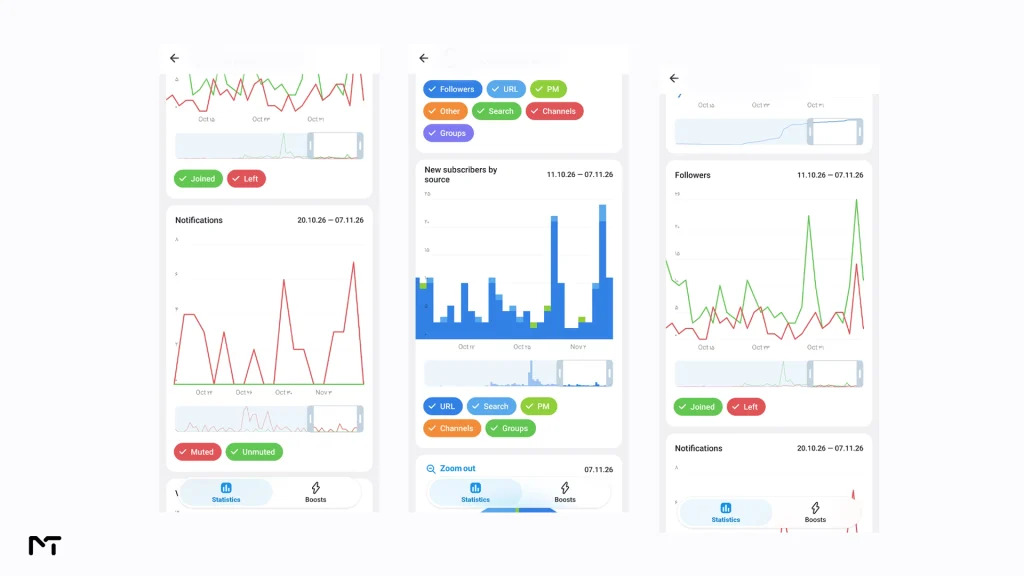
Before you change a single post, open the channel, tap its name and look for Statistics. Telegram has lowered the threshold for that screen over the years, and current guides put it at 50 subscribers, so if you cannot see it yet, your channel is probably just under that line. In that case the named invite links in reason 8 will give you most of the same answers.
Telegram’s built in statistics show follower growth, how many people muted the channel, views by source, new followers by source and the languages of your audience. Three questions are enough to locate the problem. Where did your latest followers come from? When people clearly see your link, how many actually join? And of the people who joined, how many are still reading a few weeks later?
One more quick check is to divide your average views per post by your follower count and multiply by 100. Analytics platforms call this engagement rate by reach, or ERR, and a public tool such as TGStat shows it both overall and for the first 24 hours of each post. There is no universal target, because the figure varies widely between channels, so compare your number with your own early weeks and with similar channels in your niche.
One more quick check is to divide your average views per post over the first 48 hours by your total follower count. While there is no single magic target, a healthy young channel usually sees between 20 and 40 percent of its subscribers reading within two days. Compare your result with your own early weeks, or check why your native dashboard might be missing if your channel still does not show statistics when you tap the header.
Where Is Your Telegram Channel Leaking Subscribers?
Locate your broken stage first so you fix the right bottleneck
Discovery Leak
Strangers cannot find your channel in global search and no outside traffic points to your link.
Conversion Leak
Visitors click your invite link, look at the bio or pinned post for six seconds, and leave without joining.
Retention Leak
People join your channel, lose interest because of mixed topics or noise, and mute notifications.
Match what you see to the table, then start with the reasons in the last column.
| What you see | Where it is breaking | Start with reasons |
|---|---|---|
| Almost no new followers from any source | Discovery | 1, 2, 3 |
| People clearly see your link but few join | Conversion | 4, 5 |
| People join, then views fall and mutes rise | Retention and quality | 6, 7 |
| You cannot tell which of these is happening | Measurement | 8 |
| Growth was steady, then flattened | Plateau | 9 |
If two rows fit, fix the earlier stage first. A better channel page does nothing when nobody arrives, and a better posting schedule does nothing when the page puts visitors off.
1. You Are Waiting for Telegram to Send You Subscribers
Telegram does not run a For You style feed that pushes new channels to strangers. People reach a channel through search, through suggestions of similar channels that appear after they join a related one (Telegram added that in December 2023), and through links other people share. A brand new channel with no outside promotion has almost no way into any of those.
That is why a Telegram channel that is not growing in its first months is usually a distribution problem and not a content problem. Picture a freelance photographer who posts a strong portfolio piece to a new channel every day while the only audience she has sits on Instagram. Nobody there knows the channel exists, so the posts are read by a handful of friends. One story with the link and a line in her bio would do more than another month of daily posting.
Pick one outside source and run it properly this week. It can be your audience on another platform, a swap with a channel of similar size, or a small paid test through Telegram Ads. When you choose swap partners, compare their average views per post with their subscriber count, not the subscriber count alone. A channel with a big number and thin views will bring you very little.
2. People Cannot Find Your Channel in Search
Search is the one discovery surface you can influence directly, and most owners leave it empty. A channel only shows up when someone types into Telegram’s search if it is public, has a username, and uses the words those people actually type in its name and description.
A name like Daily Notes tells the search nothing. A name like Freelance Invoicing Tips tells it exactly what the channel covers, and a short description repeats the same words in plain language. Write the title and the first line of the description the way you would name a page for Google, because the logic is the same: a clear topic, a real phrase, no cleverness.
Check the basics people forget. A private channel cannot appear in search at all, and a username made of random letters and numbers is hard to share out loud or in print. Even with a public username and clean keywords, a channel sometimes does not appear for people who do not follow it because Telegram’s automated filter has placed a quiet search restriction on the page. Ask someone outside your audience to type your exact title into their search bar first, so you know you are not trying to solve a technical filter with keyword tweaks.
Sometimes a channel has the right keywords and still does not appear for people who do not follow it. Test this yourself by asking someone who is not a member to type your exact channel title into their search bar. If it does not show up for them, check the username and title for typos first, then look for anything in the description that Telegram could read as spam, such as stacks of unrelated tags or aggressive promotional wording, and clean it up. If the channel stays hidden after that, contact Telegram support instead of changing the username again and again, because repeated changes only make the channel harder for people to find.
If you have fixed the name and description and still sit far down the results for your own keywords, a service like our Telegram Search Ranking can add the push. It works on top of a clear title and never in place of one.
3. All Your Growth Depends on One Source
Plenty of channels grow nicely for a few weeks and then flatten without any change in the content. Often a single source was doing the work: one big shoutout partner, one ad campaign, one viral post. When that source dries up, the growth goes with it, and the owner starts rewriting posts to fix what is really a traffic problem.
Open Statistics and look at new followers by source. If one source makes up most of the picture, you are exposed. Imagine an admin whose crypto news channel grew thanks to a weekly mention from a larger channel. The partner changes their schedule, the mentions stop, and joins fall within days. Nothing about the news posts changed.
The fix is boring and it works: add a second and a third source before you need them. Mix the kinds, for example search, swaps with similar channels, and your own website or social profiles. Each one will be small at first, and that is fine, because the goal is that no single source can carry or sink the channel.
4. Your Channel Page Does Not Say Why Anyone Should Join
A visitor who opens your channel decides within a few seconds using four things: the name, the photo, the description and the pinned post. If those four do not answer what they get and why it is worth a notification, they leave, however good your latest post was. You end up wondering why no one is joining your Telegram channel when the real leak is happening right at the front door.
Be specific about the promise, and make the pinned post a starting point for a stranger rather than an announcement for people who already follow you.
| Weak version | Better version | Why it works |
|---|---|---|
| Updates about my business | One pricing breakdown of a software company every Tuesday | It names the topic and the schedule |
| Daily crypto news | A three line summary of the day’s crypto news in plain English | It tells the reader what format to expect |
| Welcome, join us | Start here: my five most useful posts and the rules of the channel | It gives a newcomer a path |
If you want conversation, link a discussion group so comments are switched on. A channel with open comments looks alive to a hesitant visitor, and that impression often decides the join.
The 6 Second Visitor Test: Anatomy of a High Converting Channel
68% of visitors check fewer than four messages before deciding to join or leave
Uses exact topic words people type into global search instead of vague brand slogans.
States the exact format and posting rhythm in plain language so readers know what notifications bring.
Links to your five best posts for newcomers rather than an old welcome note or outdated poll.
Shows balanced post views, active emoji reactions, and an open comment thread on recent posts.
5. Your Channel Looks Empty or Inactive
Social proof is real on Telegram. A visitor who sees a few dozen followers, posts with almost no views and no reactions has to take a leap of faith that the channel is worth following, and most will not take it. This is the cold start problem, and good content alone does not always solve it, because nobody is there to see the content.
You can improve how a channel looks honestly: publish a handful of strong posts before you promote it, turn on reactions, and make sure recent posts show real views. Some owners also seed the first members. If you decide to, a modest starter order of Telegram members from us can make sense, as long as you choose members that stay and keep the amount small. Bought numbers backfire when they drop within weeks, or when thousands of followers sit under posts that get a few dozen views, because visitors notice the gap.
Whichever route you pick, the next three posts should give people a reason to stay. The numbers get someone to look. The posts decide whether they follow.
6. Your Content Has No Clear Niche or Rhythm
Followers join for a promise and leave when the channel stops keeping it. A travel channel that posts visa news on Monday, memes on Tuesday, hotel affiliate links on Wednesday and nothing for ten days teaches its readers that nothing in it is reliable.
Write your promise in one sentence and test every post against it. Then pick a rhythm you can keep for months. Readers do not need a specific number of posts per day, and I would not trust anyone who gives you one without knowing your niche. What hurts is irregularity and overload: long silences followed by bursts, or so many posts that people mute you. Keep promotional posts in the minority, and when you change your frequency, check the muted graph in Statistics a week later to see how readers reacted.
Beyond rhythm, look at how easy your posts are to pass along. One of the main ways people discover a channel inside Telegram is when a reader forwards a post to a friend or drops it into a group chat, so check the forwards count in your post statistics. If people read your work and never forward it, try occasional reference posts such as checklists, short industry summaries or original charts that make the person sharing them look helpful. Also check your channel settings and make sure Restrict Saving Content is switched off during your growth phase. Blocking forwards protects your text from copycats, yet it also stops your happiest readers from doing your marketing for you.
Beyond rhythm, look at how easy your posts are to pass along. Because Telegram has no algorithmic feed, organic discovery inside the app happens when a reader forwards your post to a friend or drops it into a group chat. Check the Shares counter next to the view icon under your posts. Many admins accidentally kill that word of mouth by locking down their channel settings out of fear that another page will steal their work. If you want your readers to share your posts freely while you still find smart ways to protect your text from copycats, you need habits that credit your channel without blocking the forward button.
7. You Are Attracting the Wrong Audience
A channel can gain members and still fail to grow in any way that matters. Giveaways open to everyone, traffic from unrelated channels and the cheapest sources tend to bring people with no interest in your topic. They join, never read, and sometimes mute you, which drags your average views down and makes your next promotion look weaker.
Judge every source by what happens after the join, not by the join itself. Compare views per post before and after a campaign, watch the muted graph and open the languages chart. If you write in English and a large share of your new followers read another language, that source is bringing the wrong crowd. Picture a giveaway that adds a few hundred followers over a weekend while views per post stay exactly where they were. You did not grow an audience. You grew a number.
When you test a new source or run a joint promotion and worry about junk followers, use an invite link with the Request to Join option switched on. Instead of landing straight in your subscriber count, visitors tap to request access, and you approve them. That extra step can filter out some low effort joins and protects your view rate from low quality bursts. The cost is a little manual work and slightly slower growth, so use it for sources you do not fully trust rather than for everything.
When you test a new traffic source or run a joint promotion and worry about junk followers, use an invite link with the Request to Join option switched on. Instead of dropping straight into your subscriber count, visitors tap to request access, which lets you review who is coming in or approve them after a short delay. Bots and accidental clickers rarely bother with a request button, while genuine readers tap it without thinking twice. It acts as a simple filter that protects your view rate from low quality bursts.
48 Hour View Rate (ERR) Formula
8. You Do Not Know Where Your Members Come From
If you cannot say which source brings people who stay, you cannot repeat what works. Statistics shows new followers by source in broad groups, which is a start, but it will not tell you which swap partner or which post was responsible.
Telegram lets you create several invite links for the same channel and name each one, and every link counts how many people joined through it. Make one for each place you promote: a link for your Instagram bio, one for each swap partner, one for your website. Two weeks later you will know, with real numbers, what is worth repeating and what to stop paying for. It takes ten minutes and most owners never do it.
9. Your Telegram Channel Stopped Growing After a Good Start
Early growth is generous. Friends and family join, your first swaps reach fresh audiences and a shoutout lands well. Those sources are finite. Once you have used them up, growth slows, and it looks like something broke when really the first tactics just ran out.
Treat a plateau as a signal to change the inputs, not to push harder on the old ones. Add one new source, add one new format such as a short series or a weekly poll, and rewrite your pinned post so it reflects what the channel has become. If you have the budget, test a paid source on a small scale and give it its own invite link, so you know what it costs to gain a follower who stays.
Stepping off a plateau also gets easier once Telegram’s similar channels suggestions start working in your favor. Reports on Telegram’s December 2023 announcement describe those suggestions as chosen by how similar the subscriber bases of two channels are. That means cross promotions with channels inside your exact sub niche can help more than a swap with a bigger general news or lifestyle page, because they put your channel in front of readers who already follow the kind of channels yours should sit beside.
Boosts are worth knowing about at this stage. Telegram Premium users can boost a channel, and boosts raise its level, which unlocks extra features such as channel stories. If you want to reach the next level faster, buying Telegram channel boosts is one of the quicker options, but it supports a channel that already has a reason to exist. It does not create one.
Telegram Channel Not Growing: Your 7 Day Fix Plan
This plan is small on purpose, so you can finish it in a week and see what moved.
| Day | Task | Reasons it addresses |
|---|---|---|
| 1 | Open Statistics and note your top follower sources, joins versus leaves and the muted graph | 8 |
| 2 | Rewrite the name, username, description and pinned post | 2, 4 |
| 3 | Compare average views per post with your follower count and check the languages chart | 5, 7 |
| 4 | Create a named invite link for every place you promote | 8 |
| 5 | Message three channels of similar size about a swap, after checking their views | 1, 3 |
| 6 | Write your one sentence promise and a posting rhythm you can keep | 6 |
| 7 | Review the week, drop the weakest source and add one new one | 3, 9 |
After a week you will know whether the problem sits in discovery, conversion or retention. Keep working on that stage for a few weeks before you judge the result.
FAQ About a Telegram Channel Not Growing
These are the questions that come up most when growth stalls.
Why is my Telegram channel not getting new subscribers?
Usually because nobody outside the channel knows it exists, or because the channel page gives visitors no reason to join. Check where your last followers came from in Statistics first, then read reasons 1, 2 and 4.
How long should I wait before worrying?
There is no honest universal number, and anyone quoting one is guessing. Compare the channel with its own early weeks. If followers are rising and your sources are widening, patience is fine. My own rule is to give a new source a few weeks before judging it, and to change the inputs if nothing at all has moved by then.
Why do people leave my Telegram channel?
Most leave because the channel stopped matching what made them join: off topic posts, too many promotions, too many messages or long silences. The muted graph shows the people who stayed but switched you off.
Is buying Telegram members safe for growth?
It can help a new channel look credible, but it does not create readers. Members who leave or never read lower your views per post, and that is visible to everyone. If you buy, keep the amount small, choose members that stay, and make sure real content follows. If the numbers fall suddenly instead of slowly, that is a members drop and it has its own causes.
How often should I post?
Often enough that people remember you and rarely enough that they do not mute you. Start with a rhythm you can keep for two months, then adjust it using the muted graph and your views per post.
Should I remove inactive subscribers to fix my growth?
Only if obvious bots make up a large part of your list and distort your statistics. Removing real people who simply read less often shrinks your social proof without adding a single view. A better use of your time is bringing in fresh, interested readers through clean sources until they outweigh the quiet accounts, and watching your views per post, because that is the number visitors and advertisers judge you by.
Final Thoughts
A Telegram channel not growing feels like a mystery until you split it into discovery, conversion and retention. Once you know which stage is broken, the fix is usually one afternoon of work: a clearer page, one new source, a few named invite links. Start with the diagnosis, change one thing at a time, and let the numbers tell you whether it worked.
Thanks for reading, and good luck with your channel. If you want a second pair of eyes on your numbers, message @membertelsupport on Telegram.