
Tracking a competitor’s Telegram channel is possible, and you don’t need their permission or admin access to do it. Public channels expose enough metadata for third party tools to map their growth history, engagement rate, posting patterns, and even their entire promotional network.
Most social platforms hand you a public growth chart on a silver platter. Telegram doesn’t. There’s no follower count history, no trending tab, no native way to compare your channel’s performance against anyone else’s. Marketers call this kind of closed data environment “dark social,” and Telegram is one of the most opaque examples of it in the industry.
That opacity works both ways, though. While your competitors can’t easily see your numbers, you can’t see theirs through Telegram itself. The good news is that public Telegram channels leave behind enough metadata for third-party tools to build a surprisingly detailed picture of what’s actually happening inside any channel you want to study.
This guide covers the exact metrics that matter for Telegram competitor analysis, the tools that extract them without requiring admin access, and a step by step workflow to turn raw data into a real competitive edge.
Key Takeaways
- Telegram hides growth data by default, but third party tools can surface historical subscriber charts, engagement rates, and mention networks for any public channel.
- Engagement Rate (ER) is the single most important metric: healthy organic channels sit between 15% and 30%; anything below 5% usually signals fake traffic.
- TGStat, Telemetrio, and Popsters each serve a different analytical purpose and work best when used together.
- You can automate competitor monitoring so your marketing team receives real time updates the moment a rival channel posts something new.
Why Telegram Is a Black Box for Marketers
Telegram’s native channel stats are only visible to channel admins, and they only cover your own channel. There’s no public dashboard, no API endpoint that returns a competitor’s subscriber history, and no built in way to compare yourself against anyone in your niche.
Compare that to YouTube, where subscriber counts are public and third party tools have tracked historical data for years, or Instagram, where at least follower counts and post engagement are visible at a glance. Telegram gives you none of that natively.
📊 By the numbers: Telegram users generate over 1 trillion channel views every month, and the average user opens the app 21 times a day. That’s the audience you’re competing for, and most of your rivals are flying blind trying to reach it.
This matters more if you’re targeting European markets. Europe accounts for 27% of Telegram’s global user base, and competition for that audience is intensifying across every niche from finance to
e commerce to community building. Without competitive intelligence, you’re essentially running blind.
Third party analytics platforms close this gap by indexing publicly available metadata: subscriber counts, view counts, forward counts, and post frequency. They build historical databases from it. They don’t access private messages or restricted groups, and they don’t require your competitors to know they’re being tracked.
The Core Metrics: What to Track in a Competitor’s Channel
Before opening any analytics tool, you need to know what you’re looking for. These are the three metrics that actually tell you something useful.
1. Channel Age and How to Find the Creation Date
Knowing when a competitor launched their channel gives you a baseline for calculating their real average monthly growth. A channel with 80,000 subscribers that launched two years ago is growing at a very different rate than one that hit the same number in six months.
Telegram doesn’t display a creation date on the channel profile, but you can find it manually in about 30 seconds:
- Open the competitor’s Telegram channel.
- Tap the search icon (magnifying glass) at the top of the screen.
- Tap the calendar icon that appears at the bottom of the search panel.
- Scroll back to the earliest available month and year.
- Tap the first highlighted date to jump to the beginning of the channel’s post history.
- Look for the system message that reads “Channel created.” That’s your date.
Alternatively, tools like TGStat display the creation date directly on the channel overview page, which saves time when you’re analyzing multiple competitors in one session.
2. Member Growth Velocity vs. Real Engagement
A high subscriber count means nothing on its own. Before diving into competitor numbers, it helps to understand how Telegram channel views actually connect to growth so you know which signals are worth tracking and which are just vanity metrics.
The number that actually tells you whether a channel has a real audience is the Engagement Rate.
The formula is straightforward:
How to measure if a Telegram channel’s audience is real
When you’re evaluating a competitor, calculate their ER across at least 10 to 15 recent posts to get a reliable average. A single viral post can skew the numbers, so the more data points you include, the more accurate the picture.
3. Content Strategy and Posting Cadence
Beyond the numbers, you want to understand how a competitor is actually running their channel. Track three things specifically:
Posting frequency: How many times per week do they post? Channels that post daily tend to maintain higher top of mind awareness, but channels that post less frequently but more selectively often have higher per post engagement.
Content formats: Are they leaning on text posts, images, video circles, voice notes, polls, or file shares? The format mix tells you a lot about what their audience responds to and where they’ve found traction.
Content ratio: What percentage of their posts are value-driven versus promotional? If you notice a competitor with strong subscriber numbers but weak per-post performance, the reasons are usually predictable. The same patterns that explain why Telegram posts get low engagement apply to your rivals just as much as they apply to your own channel. Channels that maintain a ratio of roughly 80% value to 20% promotional tend to build more loyal audiences over time.
Top Tools for Telegram Competitor Analysis (No Admin Access Required)
These three tools cover different analytical layers. Used together, they give you a complete picture of any competitor’s channel.
| Feature | TGStat | Telemetrio | Popsters |
|---|---|---|---|
| Historical growth charts | Yes, from 2017 | Yes, hourly | Limited |
| Mention and citation tracking | Yes (full network) | Partial | No |
| Content level performance analysis | No | No | Yes |
| Fake member detection | Yes | Yes | No |
| Admin access required | No | No | No |
| Pricing | Free and Premium | Freemium | Paid |
| Best for | Deep historical research | Real time tracking | Content strategy |
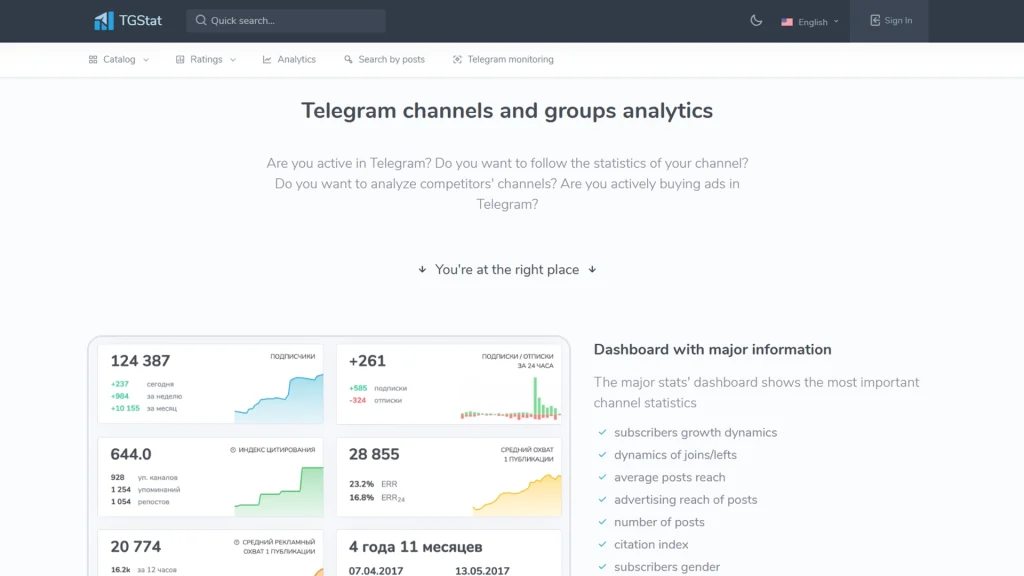
TGStat: The Deepest Historical Database
TGStat has been indexing Telegram channels since 2017, which makes it the most comprehensive source for historical data. For any public channel, you can see subscriber growth over time, the full mention and forward network, ad post history with estimated performance, and ER trends.
The Mentions tab is particularly useful for competitor research. It shows you every channel that has forwarded or cited your competitor’s content, effectively mapping their entire promotional network. Those channels are potential advertising placements for you. If they’re already promoting content in your niche, they’re likely open to a partnership or paid placement conversation.
Telemetrio: Best for Hourly Audience Tracking
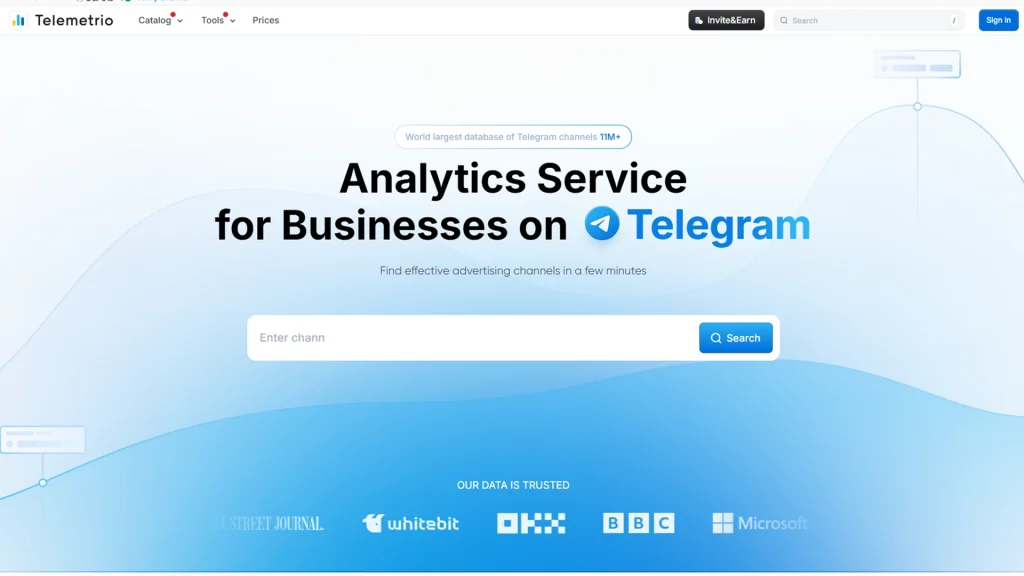
Where TGStat excels at historical depth, Telemetrio gives you granular, near real time tracking. Its hourly subscriber charts make it easy to spot exactly when a competitor gained members, whether from a cross promotion, a viral post, or a paid campaign. An unnatural spike of several thousand subscribers over a single hour with no corresponding viral post is a reliable indicator of purchased fake members. If you want a deeper breakdown of how organic and paid views differ at a technical level, this comparison of organic vs paid Telegram views covers exactly what each pattern looks like in the data.
Telemetrio also tracks cross platform performance for channels that syndicate content across multiple Telegram accounts or other platforms, which is useful for understanding how competitors distribute their reach.
Popsters: Best for Content Level Analysis
Popsters takes a different angle than the other two. Rather than tracking subscriber metrics, it analyzes individual post performance to identify which content formats, lengths, posting times, and topics generate the highest engagement for any given channel.
You can compare multiple channels side by side to benchmark your content approach against competitors and identify the formats that consistently outperform others in your niche. If a competitor’s video circles are generating twice the views of their text posts, that’s a signal worth acting on.

Advanced Strategy: Reverse Engineer Their Growth
Data collection is only the first step. Here’s how to turn those numbers into an actual competitive strategy.
Step 1: Audit Their Mention and Backlink Network
On Telegram, most channel growth happens through cross promotions and forwards rather than organic search. When another channel forwards your content, it’s the Telegram equivalent of a backlink.
Open TGStat and go to the Mentions tab for any competitor channel. You’ll see a ranked list of every channel that has referenced or forwarded their content, along with frequency data. This reveals two valuable things: who their marketing partners are and which channels in your niche have enough trust in your competitor to actively promote them.
Those same channels are potential advertising placements for your own content. If they’ve already demonstrated willingness to promote content in your category, reaching out with a sponsorship proposal is a warm conversation, not a cold one.
Step 2: Map Their Topic Authority
Look at a competitor’s last 30 to 60 posts and categorize them by topic. Which subjects do they return to consistently? Where do they get their highest engagement? Where are the gaps topics your audience clearly wants that the competitor isn’t covering?
Those gaps are where you build. Once you know which topics your competitors are underserving, the next step is making sure your own content is set up to capture that demand. A practical starting point is improving your engagement rate on Telegram before scaling your reach. A channel that dominates crypto news but never covers trading strategy or tool reviews is leaving audience demand unmet. That unmet demand is your entry point.
Step 3: Automate Competitor Monitoring in Real Time
Manual competitor tracking is time consuming and inconsistent. The more scalable approach is setting up an automated system that delivers competitor updates directly to your team the moment they’re published.
Here’s how to build it using Make (formerly Integromat):
- Create a Webhook in Make that listens for new posts in your competitor’s public Telegram channel. You’ll need a Telegram bot with read access to the channel and an API token from BotFather.
- Add a text parser module to extract the message content, strip any formatting, and pull out links or media files.
- Route the output to a private WhatsApp group or Slack channel dedicated to your marketing team. Every time a competitor posts, your team receives a clean copy of that content within seconds.
This setup is particularly useful for teams operating across different time zones or markets. Your Amsterdam based team doesn’t need to manually check five competitor channels every morning the updates land in your team’s chat automatically, already parsed and clean.
A practical note on device settings: if you’re running this automation through a local Telegram client rather than a cloud based setup, make sure background battery restrictions are disabled for Telegram on your device. Aggressive battery management on Android (especially Xiaomi HyperOS or Samsung One UI) will suspend background processes and break your monitoring sync. Cloud based automation through Make or Zapier avoids this issue entirely since it runs on external servers regardless of your device state.
Frequently Asked Questions
Can I track a private Telegram channel without admin access?
No. Private channels don’t expose their metadata to the Telegram API, so third party tools have nothing to index. All the tools mentioned in this guide only work with public channels. If a competitor’s channel is private, your best option is to join it directly as a member.
Is it legal to use third party Telegram analytics tools?
Yes. Tools like TGStat, Telemetrio, and Popsters collect and aggregate publicly available data through the Telegram API. They don’t access private messages, hidden groups, or personal user information. This approach is consistent with standard data privacy regulations including GDPR, which is relevant if you’re operating in European markets.
How do I detect fake members in a competitor’s channel?
Look for two patterns: a sudden spike of thousands of subscribers on a single day with no corresponding viral post or major promotion, and a consistently low engagement rate below 5% relative to total subscriber count. Either of these alone warrants closer inspection. Both together is a near certain indicator of purchased fake traffic.
What is a good engagement rate on Telegram?
For most niches, an ER between 15% and 30% indicates a genuinely active, organic audience. Channels with very large subscriber counts (above 100,000) often see lower ER simply because of audience dilution over time, so context matters. A news channel with 500,000 subscribers and a 10% ER is performing well. A niche community channel with 5,000 subscribers and a 6% ER has a problem.
How often should I check competitor data?
For most channel operators, a weekly review is enough to catch meaningful trends without creating noise. Set a fixed time each week to check subscriber movement, top performing posts from the past seven days, and any new mentions in TGStat. If you’ve set up the automated monitoring workflow described above, your team is already seeing competitor posts in real time, so the weekly review becomes more about pattern recognition than raw data collection.
Can I track competitor ad placements on Telegram?
Yes. TGStat’s advertising tracker logs promotional posts in any indexed channel and shows how long they stayed in the top position, estimated reach, and which channels placed the ads. This tells you exactly where your competitors are spending their promotional budgets and which placements are delivering enough performance to justify repeat investment.
Conclusion and Your Competitive Intelligence Checklist
Telegram competitor analysis isn’t about obsessing over what other channels are doing. It’s about making faster, better informed decisions for your own channel by understanding the landscape you’re operating in.
Here’s where to start:
- Find the creation date of your top three competitor channels and calculate their actual monthly growth rate.
- Run their ER over the last 15 posts using the formula above.
- Pull their Mention network in TGStat and identify three channels you could approach for cross promotion.
- Compare your content format mix against theirs using Popsters.
- Set up an automated monitoring workflow in Make so your team receives real time competitor updates without manual tracking.
If you need help setting up any part of this tracking system or want to dig into your Telegram growth strategy, reach us directly at @membertelsupport on Telegram and we’ll help you get it running.











Leave a Reply