
choose a public channel if you want people to find you through search and grow organically, and choose a private channel if you want closed, invite only access for paid content, teams, or sensitive information. That’s the core tradeoff behind Public vs Private Telegram Channels, and the rest of this guide breaks down exactly when each one makes sense.
You just opened Telegram to create your first channel, and there it is: a simple toggle asking you to choose between public and private. It looks like a small setting, but it actually shapes how people find you, how fast you grow, and who gets to see what you post. The good news is you’re not locked in forever. You can switch a channel’s type later from settings, so this decision won’t haunt you if your plans change.
This guide breaks down exactly what separates a public channel from a private one, when each makes sense, and how creators, businesses, and everyday users actually use them.
Key Takeaways
- Public channels have a permanent username (t.me/yourname) and show up in Telegram search, making them ideal for growth and reach.
- Private channels are invite only and completely hidden from search, which suits paid content, internal teams, or sensitive information.
- You can change a channel’s type later in settings, so an early mistake isn’t permanent.
- Many creators run both: a public channel to attract new people and a private one for paying members or close communities.
What Is a Public Telegram Channel?
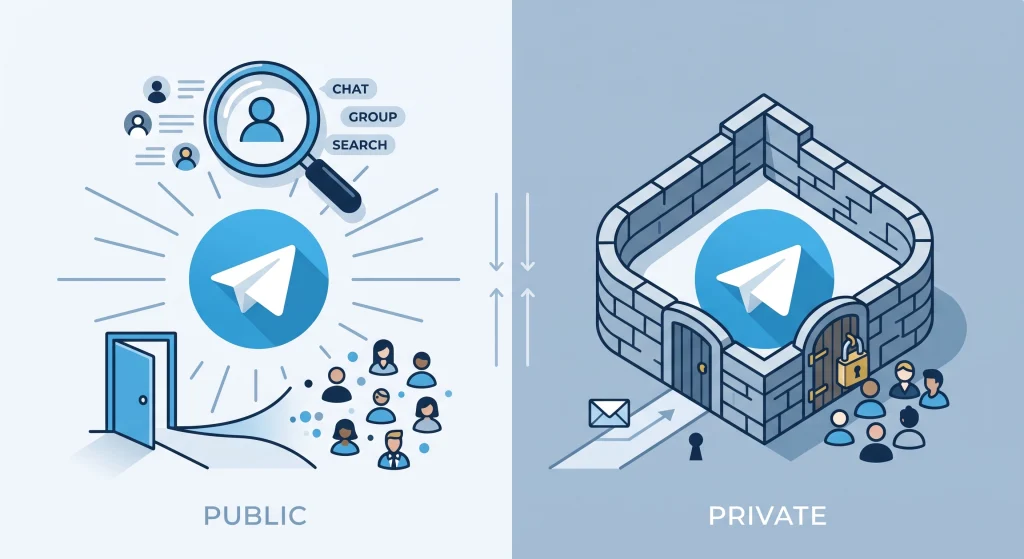
A public channel is the open, searchable version of a Telegram channel. Once you create one, you pick a username, and that username becomes a shareable link like t.me/yourname. Anyone on Telegram can type your channel name into the search bar and find you, no invite required.
Main features of a public channel:
- Has a permanent, custom username
- Appears in Telegram’s internal search
- Can be shared freely on social media, websites, or forums
- Supports unlimited subscribers
- Gives you access to built in analytics once you cross 1,000 followers
This setup works well for anyone building an audience from scratch. News outlets, bloggers, marketers, and content creators all lean on public channels because discoverability is the whole point.
What Is a Private Telegram Channel?
A private channel flips the script. There’s no public username, and it doesn’t show up anywhere in Telegram search. The only way in is through an invite link shared directly by the owner, or by being added manually. If you don’t have that link yet, there are still legitimate ways to join a Telegram private channel without admin approval, depending on how the owner has configured access.
Main features of a private channel:
- No searchable username
- Invisible to anyone without the invite link
- Access can be revoked at any time by changing the link
- Member identities and total subscriber counts stay hidden from the public
- Works with unlimited subscribers too, despite the closed setup
That level of control also matters for security. Revoking a compromised invite link is one of the fastest ways to protect your Telegram channel from hackers before they can do any damage.
Private channels fit situations where control matters more than reach. Think paid subscriptions, internal company updates, confidential document sharing, or a tight knit community that doesn’t want outsiders lurking. Determined users sometimes still try finding private Telegram channels without invitations through indirect methods, which is exactly why that access control needs to stay active rather than a one time setup.
Community growth consultants who work with creators on Telegram often frame it this way: a public channel is your storefront, and a private channel is your back room. One is built to be found, the other is built to be protected.
Public vs Private Telegram Channels: Side by Side Comparison
| Factor | Public Channel | Private Channel |
|---|---|---|
| Discoverability | Searchable on Telegram | Hidden, invite only |
| Link | Permanent t.me/username | Revocable invite link |
| Growth speed | Faster organic growth | Slower without external promotion |
| Subscriber cap | Unlimited | Unlimited |
| Best for | Brands, news, creators, SEO | Paid content, teams, sensitive info |
| Privacy of members | Standard | Higher, nothing shows publicly |
| Analytics | Available after 1,000 subscribers | Available after 1,000 subscribers |
| Monetization | Sponsored posts, affiliate links | Subscriptions, exclusive paid access |
Industry benchmarks back this up too. Public channels average around 15 percent weekly subscriber growth without any external promotion, compared to roughly 4 percent for private channels over the same period. The gap comes down to one thing: public channels can be found, private channels have to be shared.
When Should You Choose a Public Channel?
Go public if reach and discoverability are your priority.
- You’re building a personal brand or content channel and want strangers to find you organically
- You run a news, media, or update channel where wide distribution is the entire point
- You’re a business promoting products, offers, or announcements to the widest audience possible
- You want to be listed in Telegram directories and appear when someone searches your niche
- SEO matters to you, since Telegram indexes channel names and descriptions in its own search engine
That visibility isn’t limited to Telegram’s own app either. With the right setup, it’s possible to make your Telegram channel appear on Google search results, turning your public channel into another discoverable asset instead of a link that only lives inside the app.
All of that discoverability adds up fastest for businesses. For most companies weighing the best Telegram channel type for business, public wins early on, especially once you pair it with a proper Telegram competitor analysis to understand what similar channels in your niche are already doing right. A fintech newsletter, for example, typically stays public while it’s building its first few thousand subscribers, since every new follower comes through search or shared links rather than manual invites.
When Should You Choose a Private Channel?
Private makes more sense when control and exclusivity outweigh growth speed.
- You’re selling paid content, courses, or premium updates and want to gate access behind a subscription
- You manage an internal team or company channel with sensitive information
- You’re building a small, tight community where members value not being found by strangers
- You want the option to revoke access instantly if someone shouldn’t be there anymore
- Confidentiality matters more than audience size, such as legal documents or private client updates
A common real world pattern: a trading signals group starts as a small private channel among friends, then moves to a paid model once demand grows, using the invite link itself as the access gate instead of building separate payment infrastructure.
Running a private channel well over time comes down to active Telegram community management, since a closed group still needs clear rules and consistent moderation to stay valuable.
Can You Switch Between Public and Private Later?
Yes. Telegram lets you change a channel’s type at any point from the channel settings. If you started public but decide you want a closed, invite only space, you can switch, and the same works in reverse.
That said, switching isn’t free of tradeoffs. A public channel that goes private loses its searchability and username instantly, so anyone who relied on finding you through search will lose access unless they already joined. If you’re planning to monetize later, it’s often smoother to launch public, grow an audience, and only then spin off a private channel for paying members, rather than flipping your entire existing channel.
Public and Private Together: The Hybrid Approach
Plenty of successful creators don’t pick one and stop there. They run a public channel for growth and a private channel for depth.
The public channel acts as the front door. It’s searchable, shareable, and built for bringing in new followers through organic discovery, cross promotion, or social media links. Once someone’s engaged, they get invited to the private channel, which might offer premium content, direct access, or a paid subscription tier.
This setup gives you the best of both worlds. You keep growing your reach through the public side while building a more valuable, monetizable relationship with your most engaged subscribers through the private side.
Frequently Asked Questions
What is the main difference between public and private Telegram channels?
A public channel has a searchable username and can be found by anyone on Telegram, while a private channel is invite only and never appears in search results.
Is a private Telegram channel more secure than a public one?
It offers more control over who joins and hides subscriber identities, but real security depends on staying current with Telegram security updates and managing invite links and admin permissions properly, not just the channel type itself.
How many people can join a private Telegram channel?
There’s no upper limit. Private channels can hold as many subscribers as public ones, the only difference is how people get in.
Can non members see content in a private Telegram channel?
No. Content in a private channel is only visible to people who joined through an invite link or were added by an admin.
Which grows faster, a public or private channel?
Public channels usually grow faster because they’re discoverable through search and shareable links. Private channels rely almost entirely on direct invites, so growth tends to be slower unless you’re actively promoting the invite link elsewhere.
Final Thoughts
There’s no universal right answer in the Public vs Private Telegram Channels debate. It comes down to what you’re building. If reach and discoverability drive your goals, start public. If control, privacy, or exclusivity matter more, go private. And if you want both, running a public channel alongside a private one is a proven way to grow an audience while still offering something exclusive to your most loyal subscribers.
Whichever you pick, remember the decision isn’t permanent. Start with what fits your current goal, and adjust the setup as your channel grows.
Still not sure which setup fits your situation, or running into an issue while switching your channel’s type? Message our support team directly at @membertelsupport and we will walk you through it.














Leave a Reply