

If you run ads on Facebook or Instagram, you have probably noticed that campaigns get flagged faster and reviewed more closely than before. While Meta has always reviewed campaigns before launch, the older systems relied heavily on basic keyword filters and often missed complex violations until users actually complained. The Meta New Advertising Policies for 2026 introduce a highly advanced multimodal system that deeply analyzes the combined context of your text, images, and landing page simultaneously. In short, Meta moved from simple automated checks to deep contextual understanding before an ad ever gets its first impression, and that single shift explains almost everything else on this list.
Below is a full breakdown of what actually changed, why it happened, and what you need to do differently if you are managing campaigns this year.
Key Takeaways
Before diving into details, here is the short version.
- Ad review is now proactive. Meta scans text, images, audio and even your landing page before your ad gets a single impression.
- Your account carries a health score now. A low score means slower reviews and reduced delivery, regardless of your budget.
- Special ad categories such as housing, employment and credit are enforced through image and context detection, not just banned words.
- Lookalike audiences are being phased out in favor of predictive, machine learning based targeting.
- Advertisers in the EU face extra requirements tied to the Digital Services Act, including disclosure when AI generated content is used.
- Appeals now follow a structured three tier process instead of a single generic review request.
- Financial, crypto, political, professional service and healthcare ads generally need verification through Business Manager before they can run at all.
- Meta AI chat conversations are now folded into the same data used for ad targeting and personalization.

Why Meta Overhauled Its Ad Policies This Year
Meta did not make these changes out of nowhere. Regulators in the EU and elsewhere have been pushing platforms to prove they can catch misleading claims and discriminatory targeting before harm is done, not after. At the same time, user complaints about misleading health and financial ads kept climbing through the second half of last year. Meta’s response was to build a review system that catches problems earlier in the pipeline, and to tie account level consequences to a pattern of violations rather than judging each ad in isolation.
The Multimodal Ad Review System: From Reactive to Proactive
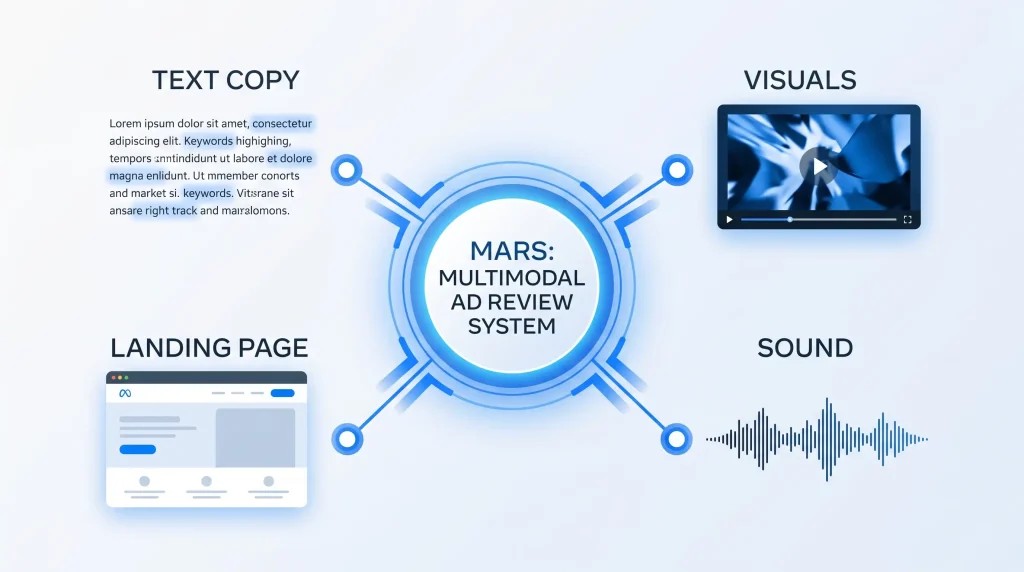
This is the center of the Meta New Advertising Policies rollout. Meta calls its new engine the Multimodal Ad Review System, and it looks at several layers of your ad at once: the written copy, the images or video, the audio track if there is one, and the landing page the ad points to.
What makes this different from older keyword based filters is context. A photo showing someone before and after a visible transformation can get flagged even without a single banned word in the caption, because the system reads the sequence of images as an implied claim. The same goes for a testimonial video where someone describes a personal journey while looking noticeably different from an earlier clip.
Practically, this means the old trick of writing safe copy while letting the visuals do the talking no longer works. Every element of the ad gets evaluated together, and mismatches between what you say and what you show are treated as one signal, not separate ones.
Account Health Score: A New Layer of Consequences
Alongside the review system, Meta introduced a running score attached to each ad account. Think of it as a track record of how often your ads get flagged, how landing pages perform, and how users respond to what you publish.
A strong score means your ads move through review quickly and get normal delivery. As the score drops, review times get longer, more ads require manual checks, and delivery can be throttled even for ads that technically follow the rules. This is a meaningful change because it means one repeat violation can quietly slow down every other campaign you run on the same account, not just the ad that got rejected.
A major technical factor that constantly influences your score is how you transmit conversion data back to the platform. Relying solely on the traditional browser pixel often leads to incomplete data drops because of strict privacy regulations and external ad blockers. Meta now heavily favors accounts that implement the Conversions API which establishes a direct server to server connection. Sending clean and consistent data through this secure method ensures the review algorithms can properly validate your landing page performance which directly helps maintain your normal delivery speeds.
If your account health drops significantly, Meta now offers a structured recovery path rather than leaving you guessing. This typically involves a short compliance training module, a written explanation of what you will change going forward, and a probation period where ads get extra manual review before they start delivering normally again.
The reality of these new health scores is that even compliant advertisers can face sudden delivery drops while they wait for human reviews. This unpredictability is exactly why many brands choose to run paid ads on Telegram channels to keep their revenue stable when their main Facebook account is restricted. It offers a much simpler review process and direct access to highly engaged niche communities without the constant fear of sudden account bans.
Special Ad Categories Are Enforced Differently Now
Housing, employment and credit ads have always had extra rules under Meta’s special ad category system, since these are areas where targeting can cross into discrimination. What changed in 2026 is how violations are caught.
Previously, advertisers could sometimes word around the rules by avoiding specific flagged terms. Now detection works across images and overall meaning rather than scanning for a fixed list of words. An ad for an apartment rental that visually signals who the “ideal” tenant looks like can get caught even if the copy itself reads as neutral.
If you work in any of these three industries, treat this as a full reset of how careful you need to be, not a minor tightening of existing rules.
New Rules Around Personal Attributes
One of the most talked about parts of the Meta New Advertising Policies update involves personal attributes. This covers things like health conditions, financial hardship, relationship status, race, religion and similar sensitive categories.
The rule itself is not new. What changed is how strictly it gets read. Ad copy that implies the platform knows something personal about the viewer, phrases built around lines like “still struggling with,” “worried about your,” or “finally solve your” problem, gets flagged even when the underlying product is completely legitimate.
The safest approach is to write from the angle of the product or service benefit rather than the user’s private situation. Instead of implying you know what the reader is going through, describe what the offer does and let the reader decide if it applies to them.
Lookalike Audiences Are Being Phased Out
If you have relied heavily on lookalike audiences for targeting, this is worth planning around now rather than later. Meta is moving away from lookalike audiences as a default targeting option and replacing them with predictive models built on aggregated behavioral data and machine learning, rather than direct data matching against a source list.
The stated goal is to reduce how much the platform depends on personal data while keeping targeting effective. For advertisers, the practical effect is that creative quality and organic engagement matter more than they used to, since the system leans more on how people respond to your content and less on matching them to a static audience profile.
This is a good moment to test broader targeting paired with stronger creative, rather than assuming narrow audience definitions will keep performing the way they did last year.
The direct replacement for these static lists is the Advantage Plus ecosystem. Since manual targeting is becoming less effective Meta wants you to trust its predictive algorithms to find your ideal buyers. You will need to consolidate your campaigns and let your ad creative do the heavy lifting for targeting. This means producing a higher volume of diverse ad angles is now the most reliable way to find new customers because the system heavily relies on real time user engagement with your videos and images to decide who sees your offer next.
As Meta forces everyone to rely heavily on its broad predictive models you might feel like you are losing direct control over exactly who sees your offer. Many marketers who feel frustrated by this loss of control choose to create telegram ads campaign funnels as a reliable alternative. This ecosystem still allows you to target specific public channels directly which means you get to pick the exact context where your message appears rather than hoping an algorithm figures it out for you.
Extra Requirements for EU Campaigns
European advertisers face additional layers under the Meta New Advertising Policies framework this year, largely tied to the Digital Services Act. Two changes matter most here.
First, artificial intelligence disclosure requirements are no longer limited to Europe, and they now apply globally across all campaigns. You must explicitly label your ad if it contains realistic AI generated content like a photorealistic image or a synthetic voice track, but it is extremely important to note that AI written text remains completely exempt from these rules.
You should also be fully aware that while many of these transparency rules originated in Europe Meta has essentially made artificial intelligence content disclosure mandatory on a global scale. The platform utilizes automated detection models that scan your uploaded assets for specific metadata footprints left by popular generation tools. If you use synthetic elements to modify a product image and fail to apply the proper label the system will automatically reject the ad and issue an immediate strike against your account health.
Second, financial and certain regulated categories need advertiser verification tied to local regulators, meaning documentation appropriate to the market you are advertising in.
If your campaigns run across multiple EU countries, budget extra time for verification steps before launch, since these checks are not instant.

Extra Verification for Regulated Industries
Beyond the EU specific rules, Meta widened advertiser verification across several regulated industries in 2026, and this is worth its own section since it affects who can even launch a campaign in the first place.
Ads promoting professional services, financial products, political content or healthcare now generally require validation through Business Manager before they run. Skipping this step does not just get a single ad rejected, it can lead to the whole account being suspended.
Cryptocurrency is treated with particular caution. According to Meta’s own Transparency Center, advertisers who want to promote cryptocurrency trading platforms, wallets, or related blockchain products must submit a recognized regulatory license or registration and get written permission through the Authorizations and Verifications section of Meta Business Suite before any crypto ad can run. Financial services advertisers face a similar pattern, with verification requirements tied to the regulator in each country they advertise in.
Meta has already rolled this out market by market. In Australia, for example, Reuters reported that Meta now requires financial advertisers to verify their beneficiary and payer details, including their Australian Financial Services License number, before any financial services ad can go live, a step introduced specifically to cut down on scam ads impersonating public figures.
If you work with clients in any of these categories, build verification into your project timeline from day one rather than treating it as a formality you can handle after the campaign is designed.
AI Chat Data Now Shapes Ad Targeting
One more shift worth knowing about touches how Meta builds its targeting profile of each user in the first place. Meta has started folding conversations people have with Meta AI into the same signals it already uses for ad personalization, alongside likes, follows and viewing history. This applies broadly, though it has been rolled out with exclusions in certain regions with stricter privacy rules, and users have not been given a way to opt out of this layer entirely, beyond the general ad preference controls Meta already offers.
For advertisers, this does not change how you write an ad, but it does mean the audience Meta serves your campaign to is shaped by a wider and more personal set of signals than before. It is a good reason to keep testing broader targeting rather than assuming last year’s audience definitions will behave the same way.
The Three Tier Appeal System
Getting an ad or account flagged is no longer a dead end, but the path back is more structured than a single “request review” button used to be.
The first tier is an automated re review, which resolves a meaningful share of false positives fairly quickly. If that does not work, the case moves to a human reviewer on Meta’s policy team, which takes longer but allows for actual back and forth on complex cases. The final tier is reserved for genuinely novel situations that need a broader policy interpretation, and this stage takes the longest.
One practical note. Resubmitting the same rejected ad without changes is treated as an attempt to dodge the rules, and it tends to make your account health worse rather than better. If a rejection feels wrong, use the review button rather than duplicating the ad.
What Changed: Quick Comparison
| Area | Before 2026 | Now |
|---|---|---|
| Ad review | Mostly reactive, after complaints or reports | Proactive scan across text, image, audio and landing page before launch |
| Special ad categories | Keyword based detection | Visual and contextual detection |
| Targeting | Lookalike audiences as a default | Predictive models based on behavior |
| Account consequences | Judged per ad | Tracked as an ongoing account health score |
| Appeals | Single generic review request | Three tier structured process |
| EU compliance | General ad rules | Added AI disclosure and financial verification steps |
| Regulated industries | Lighter review for finance, crypto, political and healthcare ads | Mandatory Business Manager verification before launch |
| Targeting data sources | Behavior, likes and follows | Same signals plus Meta AI chat conversations |
A Practical Pre Launch Checklist
Before you publish your next campaign, run through this list.
- Check that your visuals and copy tell the same story. Do not let an image imply something your text avoids saying directly.
- Reread your copy for phrases that assume something personal about the reader’s health, finances or relationships.
- Confirm your landing page matches what the ad promises, since the review system checks that page too.
- If you are in housing, employment or credit, review your creative for anything that could visually suggest a preferred audience type.
- If you use AI generated copy, images or voice in an EU campaign, add the required disclosure.
- Avoid resubmitting a rejected ad unchanged. Use the official review request instead.
- Keep an eye on your account health metrics regularly rather than only checking after a rejection.
- If you use AI generated photorealistic images or synthetic voice tracks, make sure to apply the required global disclosure, but remember that AI written text is completely exempt.
Frequently Asked Questions
What is MARS in Meta advertising?
MARS stands for the Multimodal Ad Review System, Meta’s engine for scanning ad text, visuals, audio and landing pages together before an ad starts running.
Why do ads keep getting rejected under the Meta New Advertising Policies?
Most rejections trace back to a mismatch between what an ad shows and what it says, personal attribute phrasing, or landing pages that do not match the ad’s promise.
Is the Account Health Score the same as the old ad account quality rating?
It builds on the same idea of tracking account behavior over time, but it now has a more direct and immediate effect on review speed and delivery.
Are lookalike audiences completely gone?
Not yet, but they are no longer the default targeting option, and Meta is steadily shifting weight toward predictive, behavior based targeting instead.
How do I appeal a rejected ad?
Start with the automated review request inside Ads Manager. If that does not resolve it, the case can move to a human reviewer, and complex cases can be escalated further from there.
Do I need special verification to advertise crypto or financial products on Meta?
Yes. Crypto advertisers need a recognized regulatory license and written permission through Meta Business Suite, and financial services advertisers face verification tied to the regulator in each country they target.
Does Meta use Meta AI chat conversations for ad targeting now?
Yes. Conversations with Meta AI are combined with existing signals like likes, follows and viewing history to help shape which ads and content a person sees.
Final Thoughts
The Meta New Advertising Policies for 2026 boil down to one shift in mindset. Meta is no longer waiting to see what happens after an ad goes live. It is trying to catch problems before that first impression is served, and it is tracking your account’s pattern of behavior rather than judging each ad on its own. If you build your campaigns around clear, honest creative and keep your landing pages consistent with your ad copy, you should find that these changes cause far less friction than they might seem to at first glance.
If you have questions about how any of this applies to your specific campaigns, feel free to reach out to us at @membertelsupport.














Leave a Reply